

By Lucy Willis, MD, and Renu C. Mital, MD, FACEP
One’s first unexpected bad outcome or lawsuit can be devastating. Many of us wonder why everyone else seems to be coping better. “Am I the only one who feels this way? Am I a terrible doctor?” Once you open up to a colleague, you realize that you are not alone, you are not a bad doctor, and you can dig yourself out of that shame spiral.
While we are in the business of saving lives, we are also in the business of tragedy and death. We take our careers and our oaths very seriously, and we are perfectionists. Guilt, secondary trauma, and the psychological repercussions of feeling responsible for another person’s death are occupational hazards.
Historically, physicians are unlikely to reach out for support. Our bootcamp-style training teaches us to ignore our own feelings and put one foot in front of the other.i Unfortunately, the high suicide rate in our profession demonstrates that this is not a sustainable approach.
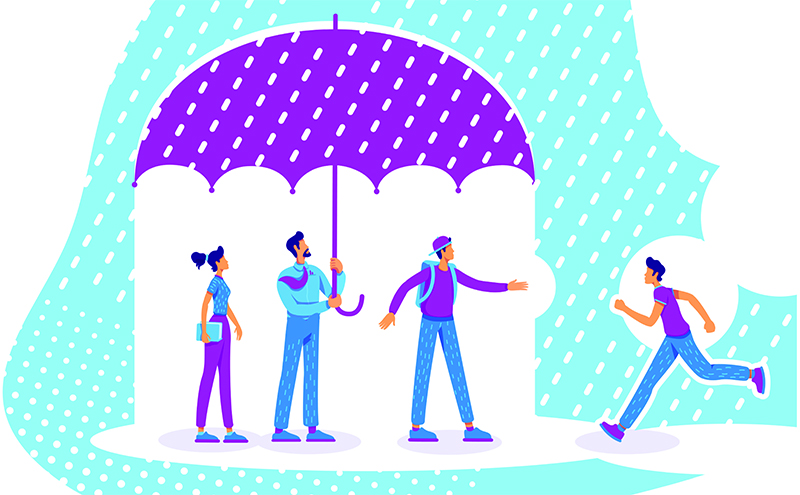
Occupational hazards demand a systemic approach to prevent and protect. An integral part of this program is peer support. There is nothing more reassuring than hearing that another respected physician has walked in your shoes. When we create a program that allows for physicians to share their stories and strategies, imperfection and vulnerability are normalized. The “culture of silence”ii is transformed into a culture of strength and stability.
There are many ways of providing peer support: opt in, opt out, group, one-on-one, case-based, interdepartmental, intradepartmental, etc. In our department, we have used three versions: group, one-on-one, and intradepartmental case-based. Our group program, Doc Box, is held both virtually and in person. It has given us the opportunity to share our fears and strategies. We discuss how we decompress at the end of a busy shift, how we cope with burnout and lawsuits. We also help each other strategize work-life integration and negotiation with leadership. Most importantly, we get to know each other outside of work, which establishes a culture of safety and trust necessary for physicians to reach out in times of crisis.
After the first wave of COVID-19 cases hit NYC, we created a one-on-one peer support program to provide an avenue of confidential support to those who may not feel comfortable expressing their feelings in a group setting. We created a network of ten senior faculty mentors to reach out to all one hundred faculty mentees, inclusive of the mentors themselves and those in leadership positions. Informal feedback was overwhelmingly positive for both the mentors and the mentees. This is a great option in times of crisis and otherwise.
Lastly, we have recently implemented an intradepartmental case-based program aimed at physicians with cases under quality review or undergoing litigation. Using trained peer supporters, we receive cases from our quality leadership and offer one-on-one peer support (opt out). In a one-year survey, 100% of respondents who accepted peer support reported that the program is a valuable resource.iii
Peer support transforms culture and encourages unity. We experience the satisfaction of providing support, and colleagues learn to lean on each other during challenging times.
i. Drummond, D. Stop Physician Burnout: What to Do When Working Harder Isn’t Working. 2014.
ii. Shapiro J, McDonald TB. Supporting Clinicians during Covid-19 and Beyond - Learning from Past Failures and Envisioning New Strategies. N Engl J Med. 2020 Dec 31;383(27):e142. doi: 10.1056/NEJMp2024834. Epub 2020 Oct 14. PMID: 33053277
iii. Willis L, McCarty ME, Lech C, et al. Report on a Formalized Case-Based Peer Support Program to Improve Physician Well-being. Physician Leadership Journal. (2025);12(5)11/28. https://doi.org/10.55834/plj.8644240482
About the Authors
Lucy Willis, MD
Assistant Professor of Emergency Medicine &
Co-Director of Faculty Wellness Committee
Weill Cornell Medicine, Emergency Medicine, New York, NY
Renu C Mital, MD, FACEP
Senior Associate Attending, New York Presbyterian Hospital
Assistant Professor of Clinical Medicine & Co-Director Faculty Wellness Program,
Weill Cornell Medicine, Emergency Medicine, New York, NY
