

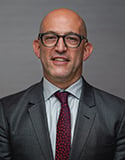
Dr. Phillip Levy is a nationally recognized expert in acute care medicine, population health, and cardiovascular disease prevention. His research on acute hypertensive heart failure and management of chronic hypertension in the ER has influenced ACEP clinical policies and established the evidence base for best practices.
Coming out of the pandemic, Dr. Levy’s work shifted to large-scale community-based healthcare initiatives, chiefly the development of a mobile health program for the state of Michigan. Initially centered on the provision of COVID-related care, his mobile program has evolved to provide barrier-free access to prevention with an emphasis on cardiovascular-kidney-metabolic syndrome screening and linkage to remote care as well as women’s health services, reaching over 125,000 individuals and across nearly 6000 events since launch in April 2020. Supported by the Michigan Department of Health and Human Services as a public-private partnership along with grants from the National Institute of Minority Health and Health Disparities, the American Heart Association, and the Centers for Disease Control and Prevention, a primary goal of this work is to improve lifespan equality in at-risk populations.
Beyond his own research, Dr. Levy has helped influence the state of science, participating in numerous national advisory committees and more than 30 grant review panels for the National Institutes of Health since 2011, serving as alternate chair for the Cancer, Heart, and Sleep Epidemiology Study Section from 2016-2020. In addition to this, Dr. Levy has a long history of service to the EM community and ACEP specifically. To that end, he served on the EMF Board of Trustees from 2016-2019; as Chair of the Research Committee from 2016-2018; as Chair or Co-Chair of the Research Forum Subcommittee from 2012-2016; as a member of the ACEP Scientific Review Committee from 2008-2019; and as a member of the ACEP Federal Funding and Liaison and Research Pipeline Subcommittees from 2008-2012. Perhaps more importantly, he has supported hundreds of his EM colleagues as they built their academic careers, directly mentoring many on their path to research success.
