
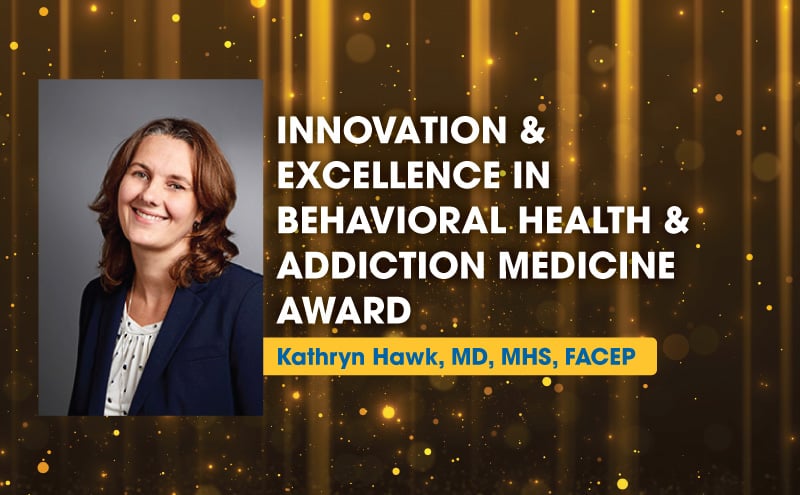


Dr. Kathryn Hawk, MD, MHS, FACEP, is an Associate Professor of Emergency Medicine at Yale School of Medicine, with secondary appointments at the Yale School of Public Health and the Yale Program in Addiction Medicine. Board-certified in emergency medicine and addiction medicine, she is an internationally recognized leader in emergency department-based addiction care, implementation science, and quality improvement.
Dr. Hawk completed research training through Yale’s NIDA-funded Drug Use, Addiction, and HIV Research Scholars (DAHRS) K12 program. Her research focuses on developing, evaluating, and implementing evidence-based interventions to reduce opioid- and alcohol-related morbidity and mortality among ED patients. She has been an investigator on numerous multicenter treatment and implementation trials through the NIDA Clinical Trials Network evaluating ED-initiated treatment for opioid use disorder (OUD). She currently leads a multisite trial comparing standard- versus high-dose buprenorphine initiation for ED patients with OUD and an NIAAA-funded clinical trial of ED-initiated medications for alcohol use disorder. She also co-leads a NIDA-funded initiative in partnership with ACEP to advance OUD quality measurement and implementation across U.S. EDs.
For more than a decade, Dr. Hawk has played a key role in ACEP's focus on translating evidence-based addiction care into routine emergency medicine practice. She coordinated the ACEP Summit on Stigma in Substance Use Disorders, co-led national educational initiatives, and chaired the development of ACEP Consensus Recommendations for ED treatment of OUD. Since 2017, she has co-led the ACEP Emergency Quality Network (E-QUAL) Opioid Initiative, a national quality improvement collaborative, engaging hundreds of EDs annually in evaluating and implementing evidence-based addiction care. She has also co-led multiple E-QUAL initiatives funded by the Foundation for Opioid Response, including Building Opioid Use Disorder and Overdose Training and Support (BOOST), which provided targeted technical assistance and implementation support to EDs seeking to establish and strengthen evidence-based OUD care.
