 American College of Emergency Physicians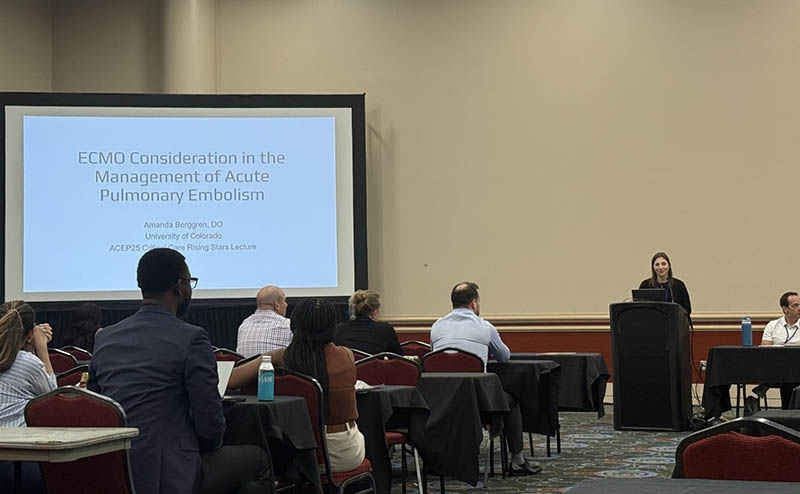

ECMO Considerations in the Management of Acute Pulmonary Embolism
Amanda Berggren, DO
University of Colorado – EM-ACCM PGY 6
Acute pulmonary embolism (PE) is a common and potentially life-threatening condition, with an estimated annual incidence of 60–120 cases per 100,000 individuals. Approximately 5% of all PE cases are classified as massive PE, a high-risk subtype characterized by sustained hemodynamic instability or any episode of pulselessness.¹ These patients face a significantly elevated risk of clinical deterioration, with reported 30-day mortality rates approaching 30%.²
The pathophysiology of massive PE occurs due to right ventricular overload. When a thrombus lodges in the main pulmonary artery or its major branches, a blockage of blood flow to a portion of the lungs causes an increase in pulmonary vascular resistance and pulmonary artery pressure. The right ventricle (RV) strains to pump harder against this increased pressure, resulting in RV dilation and dysfunction. There is a shift of the interventricular septum towards the left ventricle (LV), impairing LV filling. This cascade decreases LV preload, cardiac output, and systemic perfusion. The cycle of hypotension, shock, and end-organ hypoperfusion contributes to the high mortality associated with massive PE.3
Veno-arterial extracorporeal membrane oxygenation (VA-ECMO) can be utilized in this patient population because it directly unloads the RV, providing both circulatory and oxygenation support. Indications for ECMO would be refractory cardiogenic shock unresponsive to vasopressors and inotropes, cardiac arrest, or failure/contraindications to systemic thrombolysis.4
Observational data supports the use of VA-ECMO in this setting. A retrospective analysis of the Extracorporeal Life Support Organizations (ELSO) registry reported an in-hospital mortality rate of 48.4% among patients with acute PE supported by ECMO. Notably, patients who received ECMO during cardiopulmonary resuscitation (ECPR) had a higher mortality rate (68.1%) compared to those treated with VA-ECMO without ongoing CPR (42.7%). This data supports that early cannulation – ideally prior to cardiac arrest – is associated with improved outcomes.5
VA-ECMO in massive PE is recommended as a bridge to reperfusion therapy, including systemic thrombolysis, surgical embolectomy, or catheter-directed interventions. In scenarios where reperfusion strategies are contraindicated or unavailable, VA-ECMO with anticoagulation can be considered as a stand-alone therapy, allowing time for RV recovery. A multicenter retrospective observational study of 1,060 patients across 34 centers reported an in-hospital mortality rate of approximately 57% in patients managed with VA-ECMO alone.6 The American Heart Association notes that while VA-ECMO can be definitive therapy in a subset of patients, survival is generally lower than when ECMO is combined with reperfusion therapies.7
The same observational study demonstrated patients receiving systemic thrombolysis with VA-ECMO had an in-hospital mortality rate of 48%, compared to 34% for the those undergoing surgical thrombectomy with VA-ECMO, and 43% for those treated with percutaneous catheter-directed treatment in conjunction with VA-ECMO.6 It is important to note the limitations of this data. Some of the largest case series contributing to these datasets indicate that VA-ECMO without reperfusion therapy is often used in the sickest patients, potentially confounding these results.8
The risk of major bleeding in patients with massive PE treated with VA-ECMO is substantial, with reported rates ranging from 28.8-38.5%. In some series, bleeding rates did not significantly differ between those treated with VA-ECMO alone versus VA-ECMO combined with reperfusion therapy, though it may vary based on the specific clinical context and treatment approach.6-8
Despite increasing use and encouraging observational outcomes, the current evidence supporting VA-ECMO in acute PE remains limited to retrospective studies, registry analyses, and expert consensus. The development of randomized controlled trials is essential to guide evidence-based guidelines. Looking ahead, the role of VA-ECMO in massive PE management will depend on refining patient selection, defining clearer indications for earlier intervention, and shifting beyond its traditional use as a rescue therapy. Additionally, reducing bleeding complications through personalized anticoagulation strategies will be crucial. Together, these advancements aim to improve patient outcomes while minimizing risks.
References:
- Freund Y, Cohen-Aubart F, Bloom B. Acute pulmonary embolism: a review. JAMA. 2022;328(13):1336–1345. doi:10.1001/jama.2022.16815
- Giri J, Sista AK, Weinberg I, Kearon C, Kumbhani DJ, Desai ND, Piazza G, Gladwin MT, Chatterjee S, Kobayashi T, Kabrhel C, Barnes GD. Interventional therapies for acute pulmonary embolism: current status and principles for the development of novel evidence: a scientific statement from the American Heart Association. Circulation. 2019;140(20). doi:10.1161/CIR.0000000000000707
- McGuire WC, Sullivan L, Odish MF, et al. Management strategies for acute pulmonary embolism in the intensive care unit. Chest. 2024;166(6):1532-1545. doi:10.1016/j.chest.2024.04.032
- Abdulaziz S MBBS, Kakar V, Kumar PG, et al. Mechanical Circulatory Support for Massive Pulmonary Embolism. J Am Heart Assoc. 2025;14(1):e036101. doi:10.1161/JAHA.124.036101
- Rivers J, Pilcher D, Kim J, Bartos JA, Burrell A. Extracorporeal membrane oxygenation for the treatment of massive pulmonary embolism: an analysis of the ELSO database. Resuscitation. 2023;191:109940. doi:10.1016/j.resuscitation.2023.109940
- Stadlbauer A, Verbelen T, Binzenhöfer L, et al. Management of high-risk acute pulmonary embolism: an emulated target trial analysis. Intensive Care Med. 2025;51(3):490-505. doi:10.1007/s00134-025-07805-4
- Goldberg JB, Giri J, Kobayashi T, et al. Surgical management and mechanical circulatory support in high-risk pulmonary embolisms: historical context, current status, and future directions: a scientific statement from the American Heart Association. 2023;147(9):e276–e295. doi:10.1161/CIR.0000000000001117
- Meneveau N, Guillon B, Planquette B et al (2018) Outcomes after extracorporeal membrane oxygenation for the treatment of high-risk pulmonary embolism: a multicentre series of 52 cases. Eur Heart J 39:4196–4204. https://doi.org/10.1093/eurheartj/ehy464