 American College of Emergency Physicians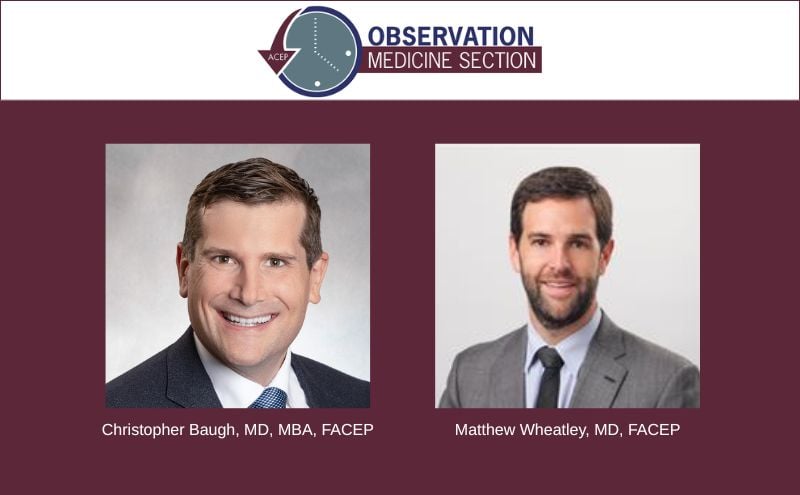

Research in Observation Medicine: Insights from Dr. Chris Baugh and Dr. Matthew Wheatley
Article and interview summarized and paraphrased by:
Praveen Mital, MD, MBA, FACEP
The interest in observation medicine continues to grow, and with it, the need for further investigative studies. As new leaders emerge in observation medicine, performing research in this field can lead to its own set of questions. In this interview article, I spoke with two scholars in the field—Dr. Chris Baugh and Dr. Matthew Wheatley—who shared insights on the future of the specialty, emerging research priorities, and this observation section community and collaboration. Their perspectives highlight not only where observation medicine is headed, but also how we can contribute meaningfully to its advancement.
Q: What advice do you have for early‑career researchers trying to establish themselves in observation medicine?
Both shared a common pain-point that occurs while doing research – the lack of resources. Often, the work is uncompensated, met with failures, and involves a multitude of non-clinical skills that most do not possess.
Dr. Baugh emphasized that building a research career is a long‑term process grounded in mentorship, persistence, and joining collaborative projects early. Despite more than 200 publications, he noted that much of his early work was unfunded—a challenge common to new investigators. Because the observation medicine research community is relatively small and reachable, new researchers can rapidly gain access to collaborators and mentorship.
Dr. Wheatley echoed the importance of mentorship and added that early‑career investigators should identify their personal strengths (writing, design, analysis) to form balanced research teams. He stressed the importance of scheduling protected time for research activities and utilizing institutional relationships to find collaborators.
Q: Where do you see the most promising research questions in observation medicine?
Observation is more than just protocols, and its impact includes hospital operational and financial improvement, as well as patient health outcomes and social well-being improvement. Both experts highlighted several high‑yield opportunities.
Dr. Baugh identified gaps in condition‑specific protocols, understudied groups such as behavioral health patients, the importance of studying patient‑level financial impacts, and post‑pandemic strategies to reduce inpatient length of stay.
Dr. Wheatley added priorities including heart failure management, the relationship between ED crowding and observation unit utilization, understanding social determinants affecting recurrent ED visits, and questions surrounding neurologic symptom management. He also emphasized the need for multi‑site data collaboration.
Q: How can clinicians turn quality improvement (QI) work into publishable research?
A common practice is to perform a QI project, realize the good outcomes, and then decide to write a paper on it. Knowing that QI projects are a regular occurrence, proactively applying the research component from the beginning may be better approach.
Dr. Baugh stressed that QI becomes publishable only when designed with rigor from the start: clear start/end dates, pre‑specified outcomes, and aligned data collection. Successful projects balance scientific quality with operational feasibility.
Dr. Wheatley reinforced the need to plan QI with research goals in mind, including early IRB consideration. He recommended using retrospective findings to launch prospective studies. Early in the project, be proactive by: 1) scheduling structured research and writing times for yourself, 2) setting monthly meetings with collaborators to stay on track, and 3) collaborating with other sites early in the project.
Q: What strategies can help researchers access statistical support and funding?
Dr. Baugh recommended developing basic statistical skills and using tools like “R” to increase independence. He encouraged leveraging junior statisticians, limited faculty‑based analytic support, internal grants, EMF funding, and senior mentor resources.
Dr. Wheatley noted the importance of targeting disease‑specific foundations, starting with smaller institutional grants, and forming partnerships with health economists or experienced researchers to strengthen proposals.
Q: What emerging innovations will shape the future of observation medicine?
Embracing the tools of artificial-intelligence (AI) and the electronic health records (EHR) can lead to some interesting research questions for observation medicine's future.
Dr. Baugh emphasized EHR‑embedded decision support, AI‑driven observation patient selection, ambient documentation, and tele‑observation models. He noted that scaling these innovations requires overcoming funding and workforce challenges.
Dr. Wheatley envisioned AI‑based prediction tools to identify which patients will succeed in observation, disease‑specific triage models, and expansion of tele‑observation and hospital‑at‑home programs.
Q: What role does community, mentorship, and collaboration play in advancing observation research?
Participating in the ACEP Observation section and connecting with its members can help anyone looking to do research in this field. Whether it's using the EngagED discussion board, reaching out via email, connecting with members at the next section meeting or a conference, or best is a direct phone call or text, reaching out to this small close-knit group of experts can make the research pursuit much easier.
Dr. Baugh emphasized that personal outreach remains the strongest tool for building collaboration in a small, highly supportive community.
Dr. Wheatley highlighted the role of the Observation Medicine Section in shaping careers and building lifelong professional relationships.
Q: How can clinicians contribute to policy advocacy in observation medicine?
Dr. Baugh encouraged clinicians to write commentary and opinion pieces and to use platforms such as JACEP Open and Substack to influence policy.
Dr. Wheatley emphasized that multi‑institutional datasets are key to successful policy advocacy because current national data sources lack observation‑specific detail.
Observation medicine continues to expand as a vital component of emergency care delivery. As these interviews show, the field’s future lies in collaboration, thoughtful study design, and the integration of innovative technologies. With leaders like Dr. Baugh and Dr. Wheatley helping to shape national priorities, early‑career researchers have a welcoming path forward. Through shared data, multi‑site initiatives, and growing advocacy efforts, this community is poised to strengthen its impact on observation through scholarly activities.
Memorable Quotes
"Observation medicine is small, welcoming, and full of opportunity for new investigators." — Dr. Baugh
"QI becomes publishable when you design it intentionally from the beginning." — Dr. Baugh
"AI prediction tools will help identify which patients truly benefit from observation care." — Dr. Wheatley
"The observation community has shaped my career and created lifelong friendships." — Dr. Wheatley