 American College of Emergency Physicians

Fall 2026 Letter from the Chair

Dear ACEP Locum Tenens Section Members,
As I approach the end of my time as Chair of the ACEP Locum Tenens Section, I have found myself reflecting not simply on the past few years, but on how far this section has come—and, more importantly, on the people who helped us get here.
When I became Chair in 2023, one of my goals was simple: I wanted locum tenens physicians to have a stronger home and presence within ACEP.
That mattered to me then, and it matters even more to me today.
Locum tenens physicians occupy a unique place in emergency medicine. We may practice in multiple hospitals, health systems, communities, and even states in the course of a single year. We step into departments experiencing staffing shortages. We care for patients in rural and underserved communities. We learn different systems, workflows, resources, and cultures—often very quickly.
And because our careers do not always fit neatly within one institution or geographic community, we can also find ourselves without some of the professional infrastructure that physicians in traditional practice environments take for granted.
That is why this section is extremely important.
Over the past several years, we have worked to create a place where physicians practicing locum tenens can connect with colleagues who understand this work, learn from one another, raise concerns unique to our practice model, and bring our collective experience to the larger conversation within emergency medicine.
I am proud of what we have accomplished together.
Our annual meeting has grown from a small gathering into an increasingly engaged community of physicians interested in how locum tenens can fit into the rigorous demands of an emergency medicine career. We have created opportunities for our members to tell their own stories and share the lessons they have learned through practice.
At ACEP25, that came to life in our panel, “Freedom in Flexibility: Locums as a Solution to Emergency Medicine Burnout.” I had the privilege of moderating a conversation with Dr. Joffre Johnson, Dr. Eyitemi Oghogho, and Dr. Niki Thran about the ways locum tenens can offer physicians greater flexibility, career control, and alternatives to traditional practice models. Their perspectives reflected exactly what makes this section truly valuable: physicians learning from physicians who are actually doing the work.
We have expanded our educational conversations beyond simply answering, “How do I find a locums job?” We have discussed how physicians can establish themselves as independent contractors, approach the business of locums strategically, schedule their work, evaluate opportunities, understand contracts and liability, and build careers that support their professional and personal priorities.
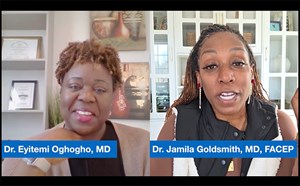
We have also created opportunities to connect outside of our annual meeting through virtual networking, educational programming, podcasts, and webinars, because a national community should not exist only for a few hours once a year at Scientific Assembly. Dr. Eyitemi Oghogho and I also recorded a podcast, “Balancing Medicine and Motherhood: Why Locum Tenens Gives Physician Parents More Freedom,” which is available on the section website. In it, we discuss how locum tenens can challenge common assumptions about instability, constant travel, and the difficulty of managing family life. We share how working in focused blocks, taking extended time off, and having greater control over scheduling can help physician parents be more present with their children, reduce burnout, and prioritize family needs. We also emphasize the importance of planning ahead, building a strong support system, and approaching locums as a customizable, entrepreneurial career path that allows physicians to design a life and career that work for them.
Just as importantly, our section has increasingly brought the perspective of locum tenens physicians into ACEP advocacy.
Our members have participated in the Council process and supported resolutions involving credentialing, EMTALA, physician communication, patient care, and other issues affecting emergency physicians. More recently, we raised an issue especially important to physicians who move between institutions: how quality-improvement and board-certification requirements can unintentionally create barriers for physicians whose practice does not occur within one traditional health system.
That is exactly the kind of work I believe our section should be doing.
Locum tenens physicians see emergency medicine from a perspective few others can. We see what works across multiple departments—and what does not.
We see the consequences of staffing shortages, boarding, inadequate resources, difficult transfer environments, changing employment models, and shifts in hospital ownership, staffing structures, and corporate practice environments across different health systems.
We understand credentialing and licensing burdens in a way physicians working at one institution may never encounter.
We know that contracts, malpractice coverage, scheduling practices, cancellation provisions, clinical expectations, and workplace conditions can directly determine whether an opportunity that looks good on paper is actually good for a physician.
And we understand something else that has become increasingly important in emergency medicine:
There is more than one way to build a meaningful career.
For some physicians, locum tenens is a temporary chapter. For others, it is a bridge between traditional jobs. It can be a way to explore different practice environments, supplement income, transition toward retirement, serve communities with significant physician shortages, or regain some control over a career that has become unsustainable.
And for many of us, myself included, locum tenens is not a transition at all. It is the career. One of the things I have most enjoyed during my tenure has been highlighting the physicians behind that work.
Our members are medical directors, educators, entrepreneurs, advocates, parents, mentors, chapter leaders, and experienced clinicians. Some have practiced locums for decades. Others are just beginning to ask whether this career model might give them something they have been missing.
Every one of those perspectives belongs in this section.
Looking Ahead to ACEP26
That commitment to practical education will continue at ACEP26. At this year’s Scientific Assembly, I will present “Locums: Opportunity or Illusion?” The session will take a deeper look at what physicians should consider before assuming that flexibility, autonomy, or a higher hourly rate automatically makes an assignment a good opportunity.
We will talk about realities that are not always visible in the recruiting pitch: evaluating the clinical environment, understanding what you are actually agreeing to in a contract, protecting your professional reputation, recognizing unsafe or poorly supported practice environments, preserving your options, and knowing when an assignment that pays well still is not worth taking.
At the ACEP Locum Tenens Section Meeting on Monday, October 5, 2026, Dr. Joffre Johnson and I will present “Pitfalls for Locum Tenens Emergency Physicians.” This session is designed especially for new graduates and physicians early in their locums journey.
There are lessons many experienced locums physicians learned through trial and error that the next generation should not have to learn the hard way. From allowing a recruiter to submit a CV without clear permission, to signing overly broad contracts, accepting poorly defined clinical expectations, failing to investigate a site before committing, or concentrating too much of one’s schedule and income with a single facility or company—the decisions physicians make before their first shift can have consequences long after it ends.
Our section meeting will also include a panel discussion on work-life balance, parenting, and building a sustainable career as a locums physician. That conversation reflects another important part of locum tenens practice: for many physicians, this work is not only about compensation or geography, but about creating a career structure that better supports family, personal priorities, and longevity in medicine.
These conversations represent exactly what I hope our section continues to do: combine practical education with the lived experience of our members.
Our collective experience has value.
If we can help a new graduate ask better questions before signing a contract, recognize a problematic assignment before arriving for the first shift, negotiate more effectively, or understand that being an independent contractor requires thinking like both a physician and a business owner, then we have done meaningful work.
That is another important role for this section: passing forward what our members have learned.
I am especially grateful to the officers, councillors, committee members, ACEP staff, speakers, contributors, and members who gave their time and ideas during my tenure. I also want to extend special thanks to Kelly Peasley, our section staff liaison, for her guidance, support, and partnership in helping our section move this work forward. A Chair may help set a direction, but a section is built by the people willing to participate in it.
Thank you to those who attended meetings.
Thank you to those who spoke on panels and webinars.
Thank you to those who wrote articles and shared resources.
Thank you to those who represented us at Council.
Thank you to those who asked difficult questions and pushed us to think about what our section could become.
And thank you to every member who simply showed up and helped demonstrate that physicians practicing differently still deserve representation within our specialty.
As leadership transitions, I hope our section continues to build on what we have started. I want us to become an even stronger resource for residents and early-career physicians who deserve to know all of their career options before signing their first contract.
I want us to continue developing practical resources that help physicians evaluate assignments, understand contracts, navigate credentialing and licensing, establish their businesses, and protect themselves professionally.
I want us to continue advocating when policies designed around traditional employment unintentionally disadvantage physicians whose careers cross institutional and state lines.
I want us to continue collaborating with other ACEP sections and leaders when the perspective of locum tenens physicians can help inform the broader specialty. And above all, I want us to continue highlighting our members.
Because the greatest resource this section possesses is not a webinar, a document, or a meeting.
It is the collective experience of the physicians in this section and throughout our membership.
When I wrote my first Chair’s letter in 2023, I said that I wanted to expand our reach, grow our membership, address the needs of our members, and highlight their contributions. Three years later, I am proud of the progress we have made. But I am even more excited about what this section can become.
Emergency medicine continues to evolve. Physician employment continues to evolve. The ways physicians define flexibility, autonomy, sustainability, and career success are changing with it.
Our section should have a voice in those conversations.
There is still work to do. There are still physicians who need this community and should consider joining it. There are still issues unique to our practice that deserve representation. And there are still stories within our membership that ACEP—and emergency medicine—needs to hear.
It has been one of the great honors of my professional career to serve as your Chair. Thank you for trusting me to help lead this section. Thank you for helping build it. And most importantly, please continue the work.
With gratitude,
Jamila Goldsmith, MD, FACEP
Chair, ACEP Locum Tenens Section