 American College of Emergency Physicians

Quick Returns and Runs of Nights: Scoring the Emergency Department Schedule With Two Fatigue Models
Shuhan He, MD, Chair of EMI Section
An emergency physician finishes a night shift at 07:00 and is due back for an evening shift at 15:00. A colleague is working three nights in a row. Harrison and colleagues followed 22 emergency physicians, both residents and attendings, for four weeks with sleep logs, actigraphy (a wrist activity monitor) and a vigilance test [1]. Alertness and performance peaked around 16:00 and were lowest on night shifts, when sleep was also shortest, and residents tended to cluster nights in a row even though sleep debt built up across them.
Part 1 of this series counted quick returns and backward rotations in a month of shifts. We ran two published fatigue models, a risk index and an alertness model, on made-up schedules that keep the shifts and hours fixed and change only their order.
A risk index and an alertness model
Simon Folkard and David Lombardi pooled the trends in injuries and accidents from published studies of shift work into an additive risk index [2]. A shift's relative risk adds values for its type (a first day shift 1.00, a first night 1.06 and, by our interpolation, a first evening 1.03), its place in a run of that type (a second night adds 0.06, a third 0.17 and a fourth 0.36; day and evening shifts add 0.02, 0.07 and 0.17) and its length (a 10-hour shift adds 0.13 and a 12-hour shift 0.275 over 8 hours). Folkard and Lombardi wrote that the index needed further validation before general use [2].
The three-process model of alertness, from Torbjörn Åkerstedt, Simon Folkard and Christian Portin, adds a homeostatic process, which falls the longer a person is awake and recovers during sleep, to a circadian process, the body clock, which peaks in the late afternoon and reaches its low near 05:00 [3]. Its third process, sleep inertia (grogginess on waking), is left out. On its scale, 14 is high alertness, 7 is the sleepiness threshold and 3 is extreme sleepiness. Ingre and colleagues found that its predictions tracked sleepiness ratings from 136 airline crew members [4]. We placed sleep with rules drawn from the two papers [3,4], the same rules an alertness calculator applies: bed at 23:00, or an hour after a shift that ends later; 8 hours of sleep, but 4.5 hours when sleep starts between 06:00 and 12:00; up an hour before the next shift; no naps.
We scored 8-hour shifts starting at 07:00, 15:00 and 23:00 and 12-hour shifts starting at 07:00 and 19:00. Unless noted, the comparisons that follow kept their direction under five variants of the alertness model from the two papers, which change the recovery during sleep, move the body clock's peak 1.5 hours earlier, add a 12-hour rhythm, let the model place sleep, or combine three of these. A 1.5-hour nap ending 2 hours before the first night of each run, the planned nap that ACEP's resource paper on shift work says the American Academy of Sleep Medicine recommends [5], cut a first night's time below 7 from 6.0 to 4.2 hours and changed no comparison's direction. Both models describe a typical person, and the risk index rests on data from industry and transport rather than from emergency departments.
Forward and backward rotation with the same six shifts
The forward week ran two day shifts, two evenings and two nights, with 24 hours off before each change of shift time. The backward week ran the same shifts in reverse, so a night ended at 07:00 before an evening at 15:00, and an evening ended at 23:00 before a day at 07:00 (Figure 1). Each of those changes is a quick return, under 11 hours of rest. ACEP's paper recommends clockwise, or forward, rotation, which takes advantage of the body clock's tendency to run late [5].
The risk index gave both weeks 1.05, since it has no term for rest between shifts or for the direction of rotation. In the alertness model, the evening after the second night began on 4.5 hours of day sleep and ended at 7.1, just above the sleepiness threshold, against 8.5 and 8.8 for the forward week's evenings. The day shift after an evening began on 6 hours of sleep at 9.8, against 10.9 and 10.6 for the forward week's day shifts, which followed 7 hours of sleep. Over the week, both spent about 13 hours on shift below 7 (backward 13.3, forward 12.9), all of it on the two nights.
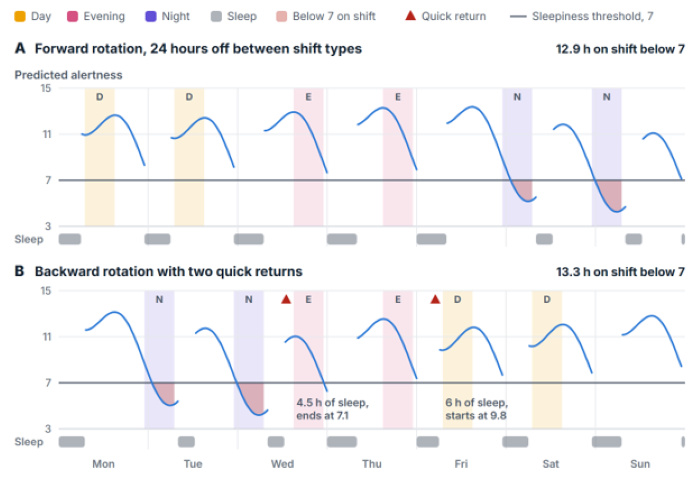
Figure 1. Both weeks spend about the same time below the threshold; the backward week pays after each quick return. Predicted alertness from the three-process model across a made-up week of six 8-hour shifts (day 07:00 to 15:00, evening 15:00 to 23:00, night 23:00 to 07:00), the same shifts in both panels. A, Forward rotation with 24 hours off before each change of shift time. B, Backward rotation with two quick returns (triangles), from a night to an evening and from an evening to a day, 8 hours apart. The line is drawn while awake; gray bars show assumed sleep (bed at 23:00 or 1 hour after a later shift, 8 hours, 4.5 hours when sleep starts between 06:00 and 12:00, up 1 hour before a shift, no naps). Shading marks hours on shift below 7, the model's sleepiness threshold: 12.9 hours in A and 13.3 in B, all on nights. Both weeks score 1.05 on the risk index, with runs counted by shift type, as its formula is written. Simulation.
What 11 hours of rest buys after each kind of shift
Vedaa and colleagues found that sleep duration and sleepiness appeared to differ across the three kinds of quick return, evening to day, night to evening and day to night [6]. The 11 hours that define a quick return match the minimum daily rest in Europe's working time directive [7], and Part 1's swap simulation treated 11 hours as enough rest after any shift. In the alertness model, the sleep a gap allows depends on when the gap falls (Figure 2). After an evening shift that ends at 23:00, 10 hours off leaves room for a full 8 hours of sleep. After a night shift, sleep holds at 4.5 hours of day sleep until the gap reaches 17.5 hours, so 11 hours after a night allows only 4.5 hours of sleep. A shift that started 11 hours after a night, at 18:00, fell to 5.4 by 02:00. After a night shift, rest counts only once it spans a full night in bed.
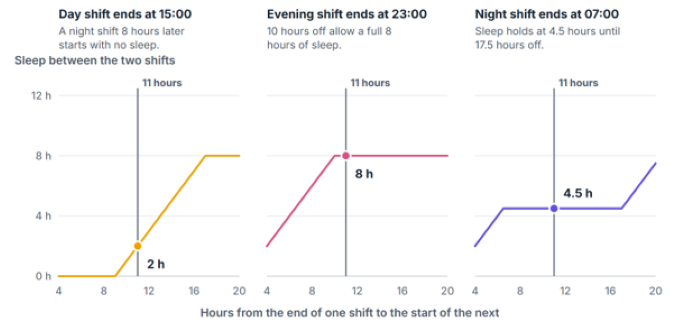
Figure 2. Eleven hours off allows a full night's sleep only after an evening shift. Assumed sleep between two 8-hour shifts against the hours from the end of the first to the start of the second. Each panel holds the first shift fixed, a day (ending 15:00), an evening (ending 23:00) or a night (ending 07:00), and moves the start of the second. Sleep follows the rules used with the three-process model: bed at 23:00, or 1 hour after a shift that ends later; 8 hours, but 4.5 hours when sleep starts between 06:00 and 12:00; up 1 hour before the next shift; no naps. The vertical line marks 11 hours, the gap that defines a quick return. With 11 hours off, sleep is 8 hours after an evening, 4.5 after a night and 2 after a day shift. Model rules, made-up shifts.
Three nights in a row against three single nights
ACEP's paper contrasts long stretches of nights with as few nights in a row as possible, and notes that working four to seven nights in a row is universally condemned [5]. For three 8-hour nights, both models favored single nights (Figure 3). The risk index rose from 1.06 on the first night to 1.12 and 1.23 on the second and third, an average of 1.14 against 1.06 for single nights. In the alertness model, a first night spent 6.0 of its 8 hours below 7, and each later night in the run followed 4.5 hours of day sleep. The lowest alertness fell from 5.0 to 4.2 and then 3.8, and the run spent 21.2 hours below 7 against 18.8 for single nights. Each later single night spent 6.4 hours below 7, more than the first, because some sleep debt carried across each day off. Harrison and colleagues concluded that clustering all night shifts in a row should probably be discouraged [1]. The alertness model holds the body clock fixed, so it cannot show adaptation to nights, which ACEP's paper calls a myth [5]. Neither model scores the disrupted day off after each single night.
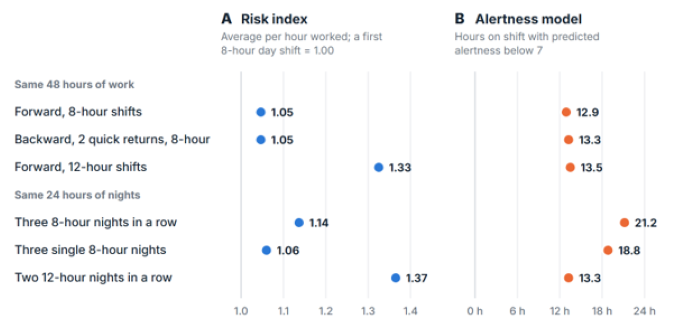
Figure 3. Both models favor single nights and the 8-hour week. Six made-up patterns in two groups with the same hours of work. A, Folkard and Lombardi risk index, in which each shift adds a value for its type, its place in a run of that type and its length, averaged here over hours worked, with a first 8-hour day shift at 1.00 and a break every 4 hours assumed. B, Hours on shift with alertness below 7 in the three-process model, with the sleep assumptions of Figure 1. The 48-hour weeks are the two of Figure 1 and a 12-hour forward week (two 07:00 to 19:00 days, then two 19:00 to 07:00 nights). The night groups cover the same 24 hours of nights; single nights fall every other day. Two 12-hour nights spend fewer hours below 7 than three 8-hour nights because they are one fewer night; each spends as long below 7 as the first or second 8-hour night (6.0 and 7.3 hours). Simulation.
12-hour and 8-hour shifts covering the same hours
Two 12-hour nights cover the same 24 hours of night work as three 8-hour nights, in one fewer night. They raised the risk index, averaged over hours worked, by 20%, from 1.14 to 1.37, because it adds 0.275 to every 12-hour shift (Figure 3). In the alertness model, each 12-hour night spent the same time below 7 as the first two 8-hour nights, 6.0 and 7.3 hours, because its extra evening hours stayed above 7. The pair's 13.3 hours against 21.2 for three 8-hour nights came from working one fewer night through the early-morning low. The alertness model has no term for time on task, and Åkerstedt and colleagues listed time on task among the model's most urgent gaps [3].
We also rebuilt the forward week with 12-hour shifts, two days and then two nights for the same 48 hours. Both models rated this 12-hour week worse than the 8-hour week, the risk index by a wide margin (1.33 against 1.05) and the alertness model by a narrow one (13.5 against 12.9 hours below 7) that closed in two of the five variants (Figure 4).
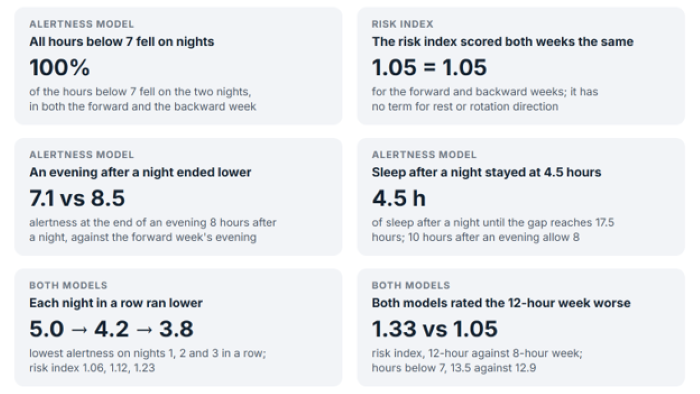
Figure 4. Nights hold the hours below 7, and the risk index cannot see rest. Six results from the made-up schedules in Figures 1 to 3, each with the model number behind it. The 12-hour week is the forward week rebuilt with 12-hour shifts (two 07:00 to 19:00 days, then two 19:00 to 07:00 nights) for the same 48 hours. The risk index pools injury and accident trends from industry and transport; the alertness model describes a typical person with the sleep assumptions of Figure 1 and no naps. Simulation.
What an informatics team can do now
- Score each draft schedule with a risk index calculator and the alertness model before posting it.
- Report both scores, since the risk index counts runs and shift length and the alertness model tracks sleep.
- After a night shift, schedule the next shift only after a full night in bed.
- Check night-to-evening and day-to-night quick returns first.
- Keep runs of nights short.
The bottom line
In the alertness model, every hour below the sleepiness threshold in both rotating weeks fell on a night shift, and the risk index rose along each run of nights. The risk index has no term for quick returns or rotation direction; the alertness model shows their cost on the next shift but little change over a week. Both models favored single nights over three in a row and rated the 12-hour week worse than the 8-hour week.
Join the discussion on EngagED
Does your group schedule nights in a row or as single shifts? Tell the Emergency Medicine Informatics Section on EngagED.
References
- Harrison EM, Walbeek TJ, Maggio DG, Herring AA, Gorman MR. Circadian profile of an emergency medicine department: scheduling practices and their effects on sleep and performance. J Emerg Med. 2020;58(1):130-140. doi:10.1016/j.jemermed.2019.10.007
- Folkard S, Lombardi DA. Modeling the impact of the components of long work hours on injuries and "accidents." Am J Ind Med. 2006;49(11):953-963. doi:10.1002/ajim.20307
- Åkerstedt T, Folkard S, Portin C. Predictions from the three-process model of alertness. Aviat Space Environ Med. 2004;75(3 Suppl):A75-A83.
- Ingre M, Van Leeuwen W, Klemets T, et al. Validating and extending the three process model of alertness in airline operations. PLoS One. 2014;9(10):e108679. doi:10.1371/journal.pone.0108679
- American College of Emergency Physicians. Circadian rhythms and shift work. Policy resource and education paper. Revised July 2026.
- Vedaa Ø, Harris A, Bjorvatn B, et al. Systematic review of the relationship between quick returns in rotating shift work and health-related outcomes. Ergonomics. 2016;59(1):1-14. doi:10.1080/00140139.2015.1052020
- European Parliament, Council of the European Union. Directive 2003/88/EC of 4 November 2003 concerning certain aspects of the organisation of working time. Off J Eur Union. 2003;L 299:9-19. https://eur-lex.europa.eu/eli/dir/2003/88/oj
Shuhan He, MD, is chair of the ACEP Emergency Medicine Informatics Section.