 American College of Emergency Physicians

Three-Way Swaps and Vickrey Auctions: Market Design for the Emergency Department Schedule
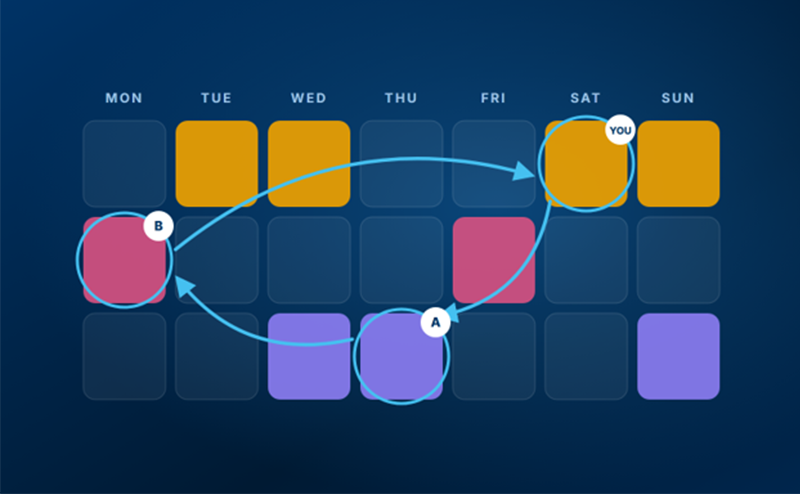
Most emergency physicians have sent this message to their group: "Can anyone take my Saturday night? Happy to take a shift for you." One colleague would take it but starts a day shift at 07:00 on Sunday, when your night ends. Another could work it, but every shift they could give back falls on a day you are away. A third is out of town. The request goes nowhere, even though two people wanted to trade.
A one-for-one swap needs a colleague who is free to work your shift and who also holds a shift you are free to work, with enough rest around both. William Stanley Jevons called this the double coincidence of wants when he explained why barter fails [1]. Kidney exchange ran into the same problem. A patient with a willing but incompatible donor needs another pair whose donor fits the first patient and whose patient fits the first donor. Alvin Roth, Tayfun Sönmez and Utku Ünver showed that exchanges among three pairs find many more transplants than pairwise swaps, while larger cycles add few more [2]. Chains that begin with an altruistic donor reach further still [3,4]. The same ideas apply to our schedules, and auction theory can price the shifts that no one picks up.
Read the schedule as data first
Most scheduling systems can publish each physician's shifts as a calendar feed, which a spreadsheet or a short script can turn into a table. Five measures from that table describe a physician's month (Figure 1). They are hours per week, nights (with the longest run of them), quick returns, backward rotations, and the share of shifts on weekends.
Quick returns, gaps of less than 11 hours between shifts, are linked to shorter sleep, sleepiness and fatigue [5]. ACEP's paper on circadian rhythms and shift work notes that most people tolerate a forward rotation, from days to evenings to nights, better than a backward one [6]. Once the shifts sit in a table, quick returns and backward rotations are easy to count, and the same table shows whether nights and weekends fall evenly across the group.
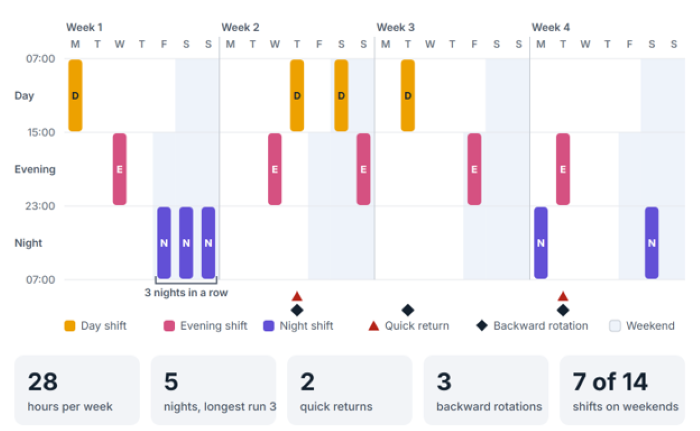
Figure 1. A month of shifts, read as data. A made-up 28-day schedule for one emergency physician. Each column is a day, read from 07:00 at the top to 07:00 the next morning, with day (07:00 to 15:00), evening (15:00 to 23:00) and night (23:00 to 07:00) shifts. Shading marks the weekend, Friday evening through Sunday. Triangles flag quick returns (less than 11 hours between shifts) and diamonds flag backward rotations (a shift that starts earlier in the day than one worked in the previous 48 hours). The tiles give the month's five measures: 28 hours per week, 5 nights with a longest run of 3, 2 quick returns, 3 backward rotations and 7 of 14 shifts on weekends.
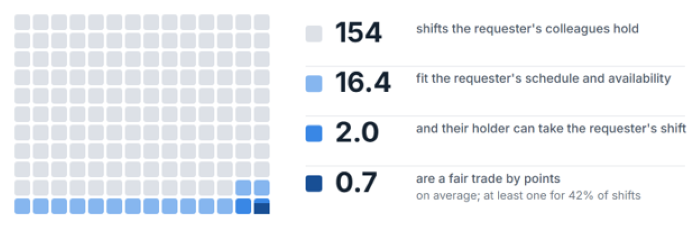
Figure 2. Why one-for-one swaps fail. Each square is one of the 154 shifts a physician's 11 colleagues hold in a simulated 28-day block (12-physician groups, 4,200 shifts across 25 made-up schedules; averages per shift). On average, 16.4 fit the requester's schedule and availability; for 2.0, the colleague who holds the shift can also take the requester's shift; and 0.7 are a fair trade by points, so the last square is filled to 0.7. Base case: each physician is available on four in ten of their days off. A one-for-one swap existed for 42% of shifts.
Cycles and chains
A three-way swap needs no double coincidence (Figure 3A). Colleague A takes your shift and hands one of their own shifts to colleague B, and B hands one of theirs to you. Each person gives one shift and gets one, so the three shifts move in a cycle. If your scheduling system records only two-person trades, you can still enter the cycle as two ordinary swaps, as long as the first swap passes its rest and overlap checks.
A chain ends with a colleague who wants an extra shift (Figure 3B). A takes your shift and hands one of theirs to B, who keeps it. Only B works more, and you work one fewer. The colleague who wants an extra shift plays the part of the altruistic donor in kidney exchange, and a chain can run through a line of several colleagues.
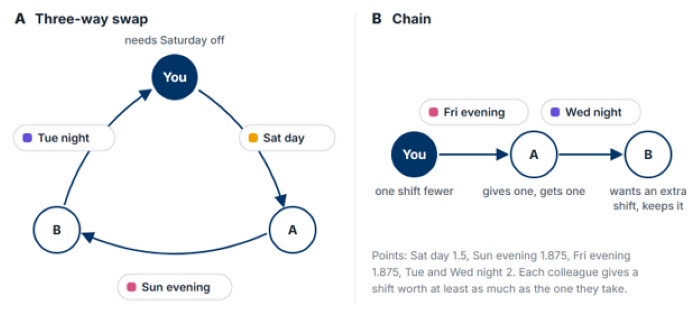
Figure 3. Two trades that need no double coincidence. A, Three-way swap. You need Saturday off. Colleague A takes your Saturday day shift and hands Sunday evening to colleague B, and B hands Tuesday night to you. Each colleague gives up a shift worth at least as many points as the one they take, and you take back a slightly heavier shift (2 points for 1.5) to get Saturday off. B, Chain. A takes your Friday evening and hands Wednesday night to B, who wants an extra shift and keeps it. Schematic.
In the simulation, three-way cycles raised the share of shifts with a trade from 42% to 65%, and cycles of up to six people reached 72%. Three-way exchanges captured most of the gain in kidney exchange too [2]. Handing a shift straight to a colleague who wanted an extra one moved 25% of shifts, and passing it through up to five colleagues first moved 85%. Cycles added more, relative to one-for-one swaps, when colleagues were rarely available (Figure 4). When each colleague was available on two days off in ten, one-for-one swaps covered 14% of shifts and cycles of up to six doubled that to 29%.
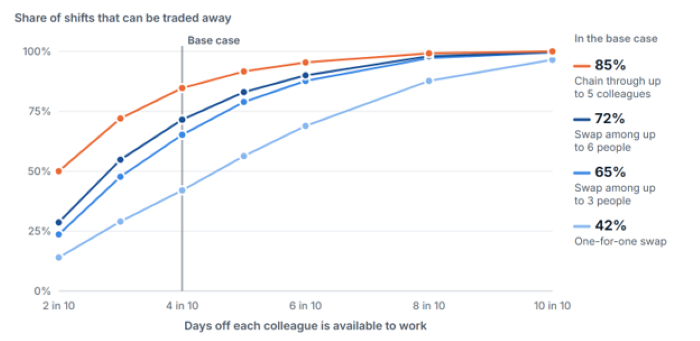
Figure 4. Cycles add more, relative to one-for-one swaps, when availability is low. Share of shifts their owner could trade away, plotted against the share of days off each physician was available to work, in simulated 12-physician groups (25 made-up 28-day schedules per point, 4,200 shifts). Lines show one-for-one swaps, swaps among up to three and up to six people, and chains through up to five colleagues that end with one of the three physicians in the group who pick up extra shifts. The vertical line marks the base case, four in ten days off available, used in Figures 2 and 5. Rules: at least 11 hours between shifts, no more than three nights in a row, no colleague takes a shift worth more points than the one they give, and the requester takes back at most 1.5 times the points given.
Weekend nights were the hardest shifts to move (Figure 5). Only 20% had a one-for-one swap and 43% had a cycle of six or fewer, because colleagues would accept nothing less than another weekend night in return. Chains did better and moved 68% of weekend nights, matching the kidney exchange finding that long chains matter most when compatible partners are scarce [4].
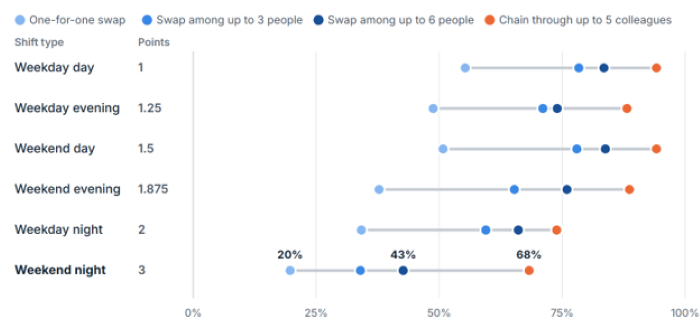
Figure 5. Weekend nights are the hardest shifts to trade. Share of shifts their owner could trade away, by shift type and its points, in simulated 12-physician groups in the base case (each physician available on four in ten of their days off; 4,200 shifts). Points: day 1, evening 1.25, night 2, multiplied by 1.5 from Friday evening through Sunday.
Shift points work as an exchange rate
The points in the simulation do the job prices do in a market. They tell each physician whether a trade leaves them better off, and over a year they show who has carried the group's nights and weekends. ACEP's shift work paper already describes such a market. Older physicians who tolerate nights poorly "often gladly 'pay' extra" to younger colleagues who take them, and some groups reward nights with fewer total shifts or fewer weekends and holidays [6]. A written point table makes those trades explicit, and a 12-month ledger of points per physician turns scheduling fairness into a number the group can check.
Pricing an open shift: rising premiums and Vickrey auctions
Sick calls and unfilled shifts need a price. One approach offers a premium that rises on a timer until someone accepts or the premium reaches its cap, the most the department will pay (Figure 6). Economists call this format a reverse Dutch auction, and it works like a first-price, or pay-your-bid, auction, in which the first physician to accept wins and is paid the premium at that moment. When physicians can enter bids in advance, the shift goes to the lowest bid as soon as the rising premium reaches it.
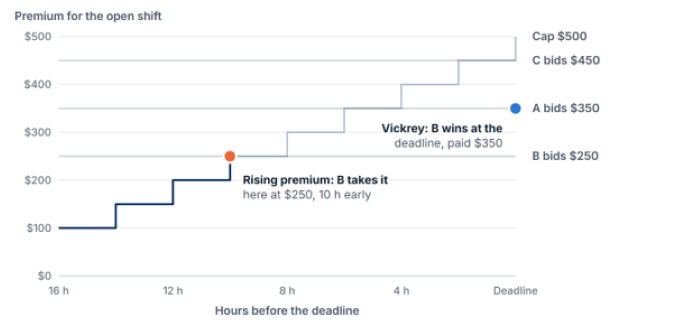
Figure 6. A rising premium for an open shift. Sixteen hours before the deadline, the premium starts at $100 and rises $50 every 2 hours to the $500 cap. Three physicians have entered bids: B $250, A $350 and C $450 (made-up values). With the rising premium, the offer reaches B's bid 10 hours before the deadline, and B takes the shift at $250. In a Vickrey auction, B wins only when every bid is in at the deadline and is paid $350, the second-lowest bid. The figure uses the same bids for both formats to compare timing; physicians bid lower in a Vickrey auction, so the average premium comes out the same (Figure 7). Schematic.
William Vickrey proposed a different auction in 1961 [7]. Everyone submits a sealed bid, the lowest bid wins, and the winner is paid the second-lowest bid. In a Vickrey auction, each physician's best bid is the lowest premium they would accept, whatever the others bid. Under a rising premium, physicians bid above that minimum, so with risk-neutral bidders the two formats cost the department the same on average [8] (Figure 7A). In an ED, they differ in how fast the shift fills, how widely the payment swings, how easily colleagues can collude and how risk aversion changes the bids.
- A Vickrey auction waits until every bid is in, so the shift fills at the deadline. A rising premium fills the moment it reaches a bid.
- Open shifts draw few bidders, and with few bidders the Vickrey payment swings widely. With three eligible physicians, the middle 80% of payments ran from $98 to $402 in a Vickrey auction and from $178 to $345 under a rising premium (Figure 7B).
- Colleagues who work together every week can agree that one bids low and the rest bid the cap. In a Vickrey auction, the low bidder then collects the cap, and no one gains by breaking the agreement. Under a rising premium, the agreement pays only if the chosen physician bids near the cap, and anyone can undercut that bid [9].
- Under a rising premium, physicians bid closer to their minimum when they would rather be sure of getting the shift, which lowers what the department pays [10]. In our model, three risk-averse bidders cost the department $200 on average under a rising premium and $250 in a Vickrey auction.
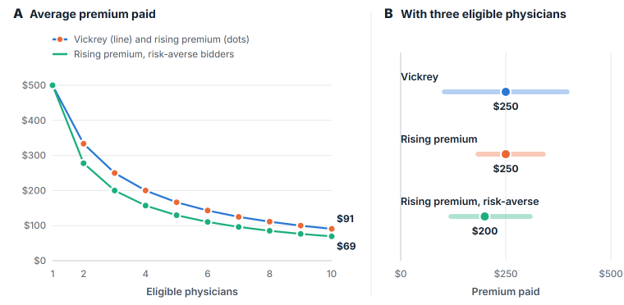
Figure 7. Same average premium with risk-neutral bidders, wider swings in a Vickrey auction. A, Average premium paid, by the number of eligible physicians. Each physician's minimum acceptable premium is drawn uniformly between $0 and the $500 cap. With risk-neutral bidders, a Vickrey auction (line) and a rising premium (dots) cost the same on average; the rising premium costs less when bidders are risk-averse (constant relative risk aversion, coefficient 0.5). B, With three eligible physicians: dots show the average premium and bars the 10th to 90th percentiles of 200,000 simulated open shifts.
Vickrey auctions are rare in practice, partly because bidders hesitate to reveal their true values and must trust the auctioneer's report of the second bid [11]. For most groups, a rising premium fits better. The share of open shifts that fill at the cap shows whether it works. If most fill only at the cap, physicians may have learned to wait, and lowering the cap will show whether they have.
What an informatics team can do now
- Pull each physician's calendar feed into a table and report the five measures for the group every month.
- Write down the swap rules: minimum rest, the longest allowed run of nights and who approves a trade.
- Agree on shift points for days, evenings, nights, weekends and holidays, and keep a 12-month ledger.
- When a one-for-one swap fails, look for a three-way swap, or a chain that ends with a colleague who wants extra shifts, before giving up. A swap check tests each one-for-one swap or giveaway for overlaps and rest.
- Offer open shifts with a rising premium, record every premium paid and review each quarter how many filled at the cap.
The bottom line
Shift swaps and open shifts are matching and pricing problems, and economists have tested tools for both. Cycles and chains find trades that one-for-one swaps miss, and chains help most with weekend shifts. A rising premium fills an open shift quickly and resists the bidding agreements a Vickrey auction invites. All of these tools need the schedule in a table first.
Join the discussion on EngagED
Has your group tried three-way swaps, shift points or premiums for open shifts? Tell the Emergency Medicine Informatics Section what worked and what did not on EngagED.
References
- Jevons WS. Money and the Mechanism of Exchange. 1875.
- Roth AE, Sönmez T, Ünver MU. Efficient kidney exchange: coincidence of wants in markets with compatibility-based preferences. Am Econ Rev. 2007;97(3):828-851. doi:10.1257/aer.97.3.828
- Rees MA, Kopke JE, Pelletier RP, et al. A nonsimultaneous, extended, altruistic-donor chain. N Engl J Med. 2009;360(11):1096-1101. doi:10.1056/NEJMoa0803645
- Ashlagi I, Gamarnik D, Rees MA, Roth AE. The need for (long) chains in kidney exchange. NBER Working Paper 18202. 2012. https://www.nber.org/papers/w18202
- Vedaa Ø, Harris A, Bjorvatn B, et al. Systematic review of the relationship between quick returns in rotating shift work and health-related outcomes. Ergonomics. 2016;59(1):1-14. doi:10.1080/00140139.2015.1052020
- American College of Emergency Physicians. Circadian rhythms and shift work. Policy resource and education paper. Revised July 2026.
- Vickrey W. Counterspeculation, auctions, and competitive sealed tenders. J Finance. 1961;16(1):8-37. doi:10.1111/j.1540-6261.1961.tb02789.x
- Myerson RB. Optimal auction design. Math Oper Res. 1981;6(1):58-73. doi:10.1287/moor.6.1.58
- Robinson MS. Collusion and the choice of auction. RAND J Econ. 1985;16(1):141-145. doi:10.2307/2555595
- Holt CA. Competitive bidding for contracts under alternative auction procedures. J Polit Econ. 1980;88(3):433-445. doi:10.1086/260878
- Rothkopf MH, Teisberg TJ, Kahn EP. Why are Vickrey auctions rare? J Polit Econ. 1990;98(1):94-109. doi:10.1086/261670
Shuhan He, MD, is chair of the ACEP Emergency Medicine Informatics Section.