 American College of Emergency Physicians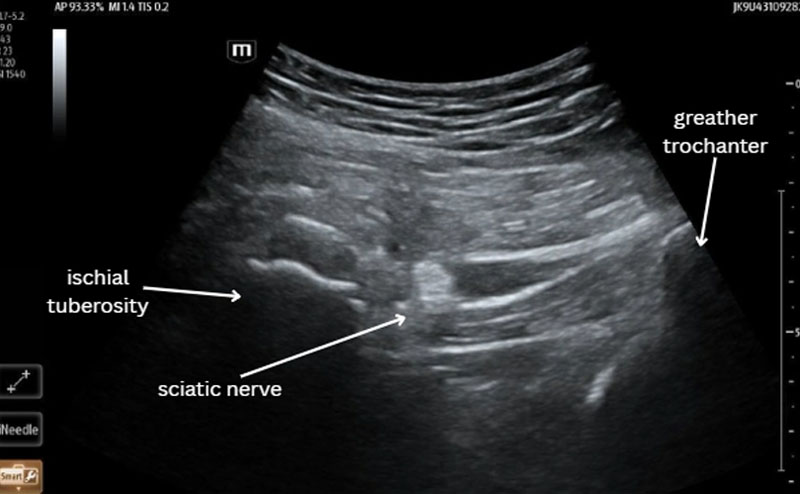

The Novel Transgluteal Sciatic Hydrodissection for Sciatica pain in the ED: A Case Report
Christopher Ikeda, DO
Kristen Kobayashi, DO
Irina Sanjeevan-Cabeza, MD
Keywords: POCUS, emergency medicine, regional anesthesia, sciatica, hydrodissection
Abstract
Sciatica is a condition that presents with pain and paresthesias from irritation of the sciatic nerve. Sciatica is treated with various modalities ranging from physical therapy to pharmaceuticals to surgery. Acute flares are a common complaint seen in the Emergency Department and can often be hard to control with medications alone. In the acute care setting, sciatica symptoms can be treated via a novel technique called the Transgluteal Sciatic Nerve Hydrodissection. This technique is similar to the more classic Sciatic Nerve Block but uses 5% dextrose in water (D5W) or a similar inactive fluid rather than a local anesthetic. This modality allows for decompression of the sciatic nerve and does not result in loss of motor function, making it ideal in the emergency department where patients can be quickly discharged post-procedure. Here we describe a patient treated with this technique in the emergency department who experienced relief of pain and improvement in ambulation. We include videos of the decompression and discuss its utility in the emergency setting.
Introduction
Sciatica is a painful pathology of the back and lower extremities resulting from compression and inflammation of the sciatic nerve. The sciatic nerve originates from the nerve roots L4 to S3 and innervates the hamstrings and lower leg via its branches. Peak incidence occurs in the fourth decade of life with lifetime incidence estimated between 10-40%.1 Patients classically report unilateral pain radiating to the distal affected extremity with some reporting paresthesias or weakness. Sciatic nerve entrapment occurs when the sciatic nerve becomes compressed during its extra-spinal course secondary to mass, muscle spasm, or trauma, leading to significant pain and disability. Piriformis syndrome is the most commonly reported manifestation of this condition, wherein the sciatic nerve becomes entrapped at the level of the ischial tuberosity.
Sciatica treatment involves physical therapy and pain medication as initial conservative therapy with surgery being reserved for refractory cases. In cases of acute sciatica presenting to the emergency department (ED), or in cases refractory to other treatment modalities, the Transgluteal Sciatic Nerve Block has been shown to be a novel method of anesthesia.2 The procedure involves injecting a local anesthetic agent such as lidocaine, bupivacaine, or ropivacaine into the space surrounding the sciatic nerve via ultrasound guidance. However, this procedure results in motor blockade of the lower extremity leading to potential risks such as ambulatory dysfunction and even falls.
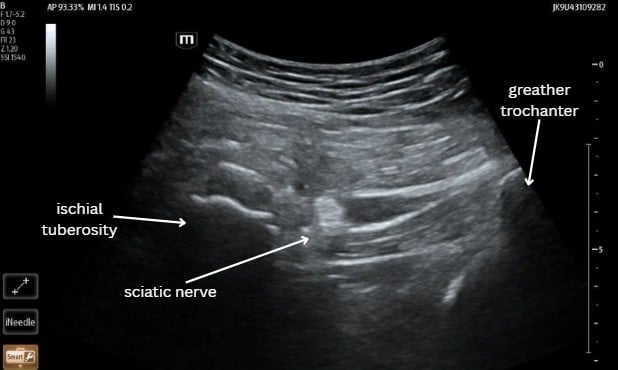
Ultrasound-guided Transgluteal Sciatic Nerve Hydrodissection (TSNH) is a similar procedure wherein D5W or a similarly inactive fluid is used to decompress the sciatic nerve. [Figure 1] This procedure causes mechanical decompression and does not cause motor blockade; it is therefore useful in the ED as patients are ambulatory after the procedure and can be safely discharged with their pain controlled. Here we present a case of a patient in the ED presenting with sciatic pain treated with this procedure.
Case
A 61-year-old male presented to the ED complaining of 2 weeks of persistent worsening right-sided back pain radiating down his right leg to his foot. He also reported numbness to his medial calf and difficulty ambulating with a walker. Pain was unrelieved by tylenol, ibuprofen, or muscle relaxants. Consent for a TSNH was obtained and the procedure was performed under ultrasound guidance using sterile technique with a 20 gauge echogenic nerve block needle. 20mL of D5W was used for hydrodissection. The patient was placed in lateral recumbent position and the anatomy was identified. [Figure 1] The needle was visualized using a longitudinal approach and D5W was deposited around the sciatic nerve. [Video 1] The patient reported improvement in his pain scale from a 10 to a 4, became ambulatory, and was discharged an hour later without complications.
 [Figure 1]
[Video 1]
Discussion
Our case demonstrates the utility of TSNH in the ED and its advantages over a traditional nerve block. The patient was both treated and discharged within 2 hours without complications. Furthermore, the patient reported no motor weakness following the procedure and was able to ambulate safely.
Ultrasound-guided nerve hydrodissection is a pain management technique and has been shown to be effective in ulnar neuropathy, carpal/radial tunnel syndrome, and saphenous and fibular neuropathy in addition to sciatic neuropathy.3 Additionally, fluids other than D5W have been studied such as corticosteroids, hyaluronidase, and platelet-rich plasma (PRP).4 The benefits of this treatment have also been shown to be long-lasting; a study by Sabbineni et al. demonstrated pain relief in patients who received nerve hydrodissection for as long as 6 months.5
As of yet, further research is needed on the utility of this technique in the emergency department where musculoskeletal pain is a common presentation and effective options are limited. We assert that ultrasound-guided nerve hydrodissection is a good option to consider if pharmacotherapy is not effective. It may be preferable to a traditional nerve block especially in the emergency department due to its expediency, effectiveness, and better side effect profile. We hypothesize the use of this technique will lead to better outcomes and increased patient satisfaction at discharge.
References
- Davis D, Taqi M, Vasudevan A. Sciatica. [Updated 2024 Jan 4]. In: StatPearls [Internet]. Treasure Island (FL): StatPearls Publishing; 2025 Jan-. Available from: https://www.ncbi.nlm.nih.gov/books/NBK507908/
- Silver D, Esener D, Rose G. Ultrasound guided transgluteal sciatic nerve hydrodissection for the treatment of acute sciatica in the emergency department. Am J Emerg Med. 2023;69:219.e3-219.e6.
- Colorado B, McNeill D, Norbury J. Ultrasound-Guided Nerve Hydrodissection for Peripheral Entrapment Neuropathies. Muscle Nerve. 2025;72(5):1052-9.
- Buntragulpoontawee M, Chang KV, Vitoonpong T, Pornjaksawan S, Kitisak K, Saokaew S, et al. The Effectiveness and Safety of Commonly Used Injectates for Ultrasound-Guided Hydrodissection Treatment of Peripheral Nerve Entrapment Syndromes: A Systematic Review. Front Pharmacol. 2021;11:621150.
- Sabbineni M, Ajmera P, Wang B, Varma V, Mbuagbaw L, Choudur HN. Exploring the therapeutic potential of ultrasound-guided nerve hydrodissection: a comprehensive retrospective analysis. Clin Radiol. 2025;85:106863.