 American College of Emergency Physicians

Pearls for the Successful Completion of the Emergency Ultrasound Fellow Research Project
Lynn Roppolo, MD, FACEP, FAEMUS
John Peter Smith Health Network
Nikolai Schnittke, MD, PhD, FAEMUS
Oregon Health and Science University
Michael Gottlieb, MD, FACEP, FAEMUS
Rush University Medical Center, Chicago, IL
Overview
The Emergency Ultrasonography Fellowship Accreditation Council (EUFAC) accredits Advanced Emergency Medicine Ultrasound (AEMUS) fellowship programs by ensuring that all accredited programs are meeting established standards. Included in these EUFAC program requirements are guidelines that require that all emergency ultrasound (EUS) fellows participate in scholarly activity, a core requirement for all residents and fellows as dictated by the Accreditation Council for Graduate Medical Education (ACGME). EUS fellows have the additional pressure of needing to complete this requirement within a fellowship training period that is only one year in duration. The purpose of this brief review is to provide EUS fellows and EUS fellowship leaders with a variety of pearls for successful completion of the EUS fellow scholarly activity requirement, primarily focusing on point-of-care ultrasound (POCUS) research.
EUS Fellowship Scholarly Activity Requirement and Why Research
The EUS fellowship program core requirements outlined by EUFAC includes details about curriculum requirements and scholarly activity requirements. In general, as part of the core requirements, the EUS fellowship curriculum should include basic principles of research and each fellow should complete a scholarly activity. The most recent EUFAC update for scholarly activity in 2023 requires that the fellow needs to be listed as an author, not necessarily first author, and that the project itself can be either a publishable research or review article that was started during the fellowship. At least one submission for presentation to a local, regional or national professional scientific meeting can also count toward this scholarly activity requirement. Additional details about this requirement are not provided which may be intentional to allow individual programs and EUS fellows some flexibility and creativity. Although there is now a non-research option for EUS fellow scholarly activity, there are several reasons why EUS fellowship programs should still consider requiring fellows to be involved in a research project during their fellowship training. (Table 1) Requiring EUS fellows to design their own research project, prepare their own Institutional Review Board (IRB) submission, and be first author for a national conference research abstract presentation may understandably seem like an unreasonable expectation for a one-year EUS fellow especially at programs who are less academic, do not have research administrative support or faculty who can serve as mentors.
Table 1. Reasons to do Research
|
Reasons to do research |
Comments |
|
Develop critical thinking skills, a deeper understanding of evidence-based medicine, and inform clinical decisions based on the available evidence |
Participation in research will help with understanding and appreciation of the science and may ultimately lead to improvements in patient care |
|
Become a true expert in at least one area |
Emergency medicine is a very broad area of medical knowledge. Research is typically focused on a very narrow question allowing the researcher to truly become an “expert” in this and related areas and to eventually build upon this interest for future research, grant funding, lectures with the potential for national recognition, collaboration and leadership opportunities |
|
Academic career advancement: curriculum vitae or CV builder for future employment and other opportunities |
Success in research is one of the currencies for academic promotion. If you are not doing research and publishing, you will need to have something else that is unique that brings you national recognition such as with major leadership positions or other excellence in teaching. |
|
Work balance and prevention of burnout |
There is a significant increase in burnout for emergency physicians working many shifts in busy emergency departments which an academic career (including research) may help prevent.1 |
|
Expand your medical community, networking, friendships |
Research is almost always a team-based effort and an opportunity to work more closely with colleagues and others in your work environment. |
|
Job satisfaction |
Research productivity adds another level of productivity and recognition outside of the clinical environment. Seeing a project to completion, presenting it at a conference, publishing it and having others acknowledge your work can be very satisfying and rewarding. |
|
Generation of future academic and leadership opportunities |
One research project can lead to many more opportunities such as higher quality studies including multi-center studies and grants, lecture opportunities, national recognition, leadership opportunities and becoming a true “expert” in your area of research interest. |
We conducted an informal survey as part of a brief didactic on this topic at the most recent annual Society for Clinical Ultrasound Fellowships (SCUF) meeting. The purpose of this google form survey was to assess how many EUS fellows, if any, were successful in publishing or presenting POCUS research scholarly activity, and if successful, what factors contributed to this success. In the last three years, of the 33 programs who responded, they collectively had 123 EUS fellows, of which, the following were reported:
- 70.1% (n=87 fellows or 87/123) were able to design at least one research project to be submitted to the home site institutional review board, and commence the project and data collection during the course of the fellowship
- 63.4% (n=78 fellows or 78/123) were able to submit at least one abstract as first author and presenter to a national meeting such as American College of Emergency Physicians (ACEP), Society of Academic Emergency Medicine (SAEM), or American Institute of Ultrasound in Medicine (AIUM) during fellowship.
In 2024, there were 147 accredited EUS fellowship programs so only 22.4% (33/147) of all EUS programs responded to our informal SCUF survey. The vast majority of EUS fellowship programs who responded had fellows who were productive with research before the end of their fellowship year or shortly after their fellowship was completed. From our collective knowledge of many programs and previous experiences of our own, the EUS fellow research scholarly requirement continues to be a challenge. The American Board of Emergency Medicine (ABEM), who certifies the physicians who successfully pass the AEMUS Focused Practice Designation (FPD) examination, recently reached out to the AEMUS community, soliciting feedback for revisions to the scholarly activity requirement for EUS fellows. The rest of this review will be a summary of high yield recommendations based on our own experiences which seemed to be in alignment with comments made in the survey mentioned above.
Getting Started and Planning EUS Fellows Research Scholarly Activity
There are many approaches to getting your new EUS fellow started with research. The EUS fellowship match is in November which allows for many months of becoming more familiar with your future EUS fellows’ scholarly interest and to even start planning a research project which can commence at the beginning of the fellowship on July 1. Unfortunately, some EUS fellows start their fellowship training with limited research knowledge and experience to know what they would be interested in studying so their research journey should begin with a research mentor who can help guide them through the process. This needs to come from the fellowship program itself. A good research mentor should have research experience, should have first author publications as a primary investigator, should have a solid foundation in research methodology, and possess those qualities we look for in good mentors and educators such as being knowledgeable, supportive, communicative and a good role model. They need to have the bandwidth to dedicate the time and effort needed to guide a fellow through their research project.
Effective planning is critical to the successful completion of a fellowship-level research project, particularly within a one-year training period. A research study that is poorly planned will not be well executed and will be unlikely to be unpublished. Despite substantial effort, not all studies ultimately result in publication. Having a research study accepted for presentation or publication adds substantial value to a curriculum vitae and strengthens a fellow’s academic profile. Unfortunately, not every research study is presented or published. Most researchers have experienced this misfortune, but the lessons learned still contribute meaningfully to future academic work. Good mentorship, a comprehensive review of existing literature, awareness of unanswered and publishable questions, familiarity with research methodology, bias-reduction strategies, and reporting guidelines, combined with organized, early planning, can greatly increase the likelihood of a successful and publishable study.
From our informal SCUF survey, programs who have been successful with EUS fellow research productivity have had one of three experiences:
- A highly motivated fellow initiates a simple study and begins early in the fellowship.
- The fellow joins an ongoing study, continuing the work of a previous trainee.
- The fellow participates in planning a new study before starting the fellowship.
Publishable research studies are well planned over several months, require an understanding of research methodology and an exhaustive review of published literature, coordination of a research team with numerous communications, multiple approvals, attention to an incredible amount of details and a countless number of unanticipated hours of work. Those who are the lead investigators of any research project are usually passionate or at least have some interest in the research area and have some curiosity about the research question at hand.
Most fellows have had at least some basic education on research methodology in medical school and residency. A fellow’s understanding of research methodology is another issue and should also be part of the fellowship curriculum. There are an abundance of resources available to build upon the fellow's basic research knowledge to advance them to the next level required for them to conduct their own research project. SAEM and ACEP each have such a course which are respectively called the ARMED (Advanced Research Methodology Evaluation and Design) course and Research Academy (formerly Emergency Medicine Basic Research Skills or EMBRS).2 Online resources can help EUS fellows learn more about research processes such as the Academy of Emergency Ultrasound (AEUS) has a research resources page on the SAEM website. The recently published textbook by Gottlieb and Panebianco called Advanced Point-of-Care Ultrasound: A Comprehensive Review has an excellent chapter on research which includes a well written discussion on the landscape of POCUS research and also provides guidance on choosing a research topic, planning research and much more.
Regarding the topic for study and the research question, start with where the fellow is currently at such as their prior experiences and interests. Many fellows start their fellowship not really knowing what they want to do with research so the research mentor plays a critical role and can help them navigate that process. Ideally, the research question should be something the fellow is already passionate about or has a sincere interest in as research takes a lot of work and doing a research study in an area the EUS fellow has no interest in may substantially increase the difficulty of project completion. Presenting the fellow with the research interests, experiences and current or proposed projects of other faculty, fellows or even residents may spark some interest. Another option is reviewing current ultrasound literature and attending research abstract presentations at conferences or listening to lectures by POCUS research experts to identify what additional research questions need to be answered or studies with limitations that could be improved with better planning. Lastly, Probing the Literature National (PTL) Journal Club is a joint endeavor with the EUS community of the ACEP Emergency Ultrasound Section (ACEP EUS) and SAEM AEUS. The PTL sessions are monthly virtual sessions and are well attended by EUS fellows and faculty both nationally and internationally. Each session focuses on a focused POCUS area and includes a critical appraisal of two main articles, a guest appearance by the author of one of the articles who leads a discussion of their own article, and ends with an informal methods consult where attendees have the opportunity to ask research advice from experienced POCUS researchers. This is yet another excellent opportunity for EUS fellows to generate research ideas and network with other EUS fellows and faculty from other programs for research advice and collaboration.
Once a research mentor has been identified, the literature reviewed, and a focused research question finalized, the next step is to carefully assemble the research team. This should include involving a statistician early in the process, as they can provide essential guidance during the development of the research protocol. Protocol development requires a thorough understanding of the selected methodology, identification of potential sources of bias and strategies to mitigate them, and meticulous attention to detail. Keeping detailed notes throughout this process is invaluable, particularly when drafting the methods section of the manuscript, which should include enough information for another researcher to replicate the study.
Conducting a brief pilot study is strongly recommended before the study goes live and formal data collection begins. A pilot allows the team to test study procedures, identify unanticipated challenges, and ensure that the protocol functions smoothly and effectively answers the proposed research question. Several logistical steps must also be addressed, including securing necessary approvals such as from the IRB and the hospital. Because IRB review can take longer than anticipated, this timeline should be carefully considered during project planning. Creating a GANTT chart early in the project planning can help organize tasks, establish realistic deadlines, and keep the research team on track throughout the study (Figure 1).
Project Structure
Each scholarly activity has a structure, which starts in the planning phase and guides the framework for writing up the study. As evidence based medicine evolved, so too did the importance of study-specific structural frameworks. When you plan your project, think about the kind of study design that would best answer the research question and still be feasible for execution by a fellow. The EQUATOR network (https://www.equator-network.org/) has several “Reporting Guidelines” covering broad study types like observational studies (STROBE - Strengthening the Reporting of Observational Studies in Epidemiology) and diagnostic accuracy studies (STARD - Standards for Reporting of Diagnostic Accuracy Studies) that are highly relevant to POCUS research. The elements of each checklist can be used to plan the study, write up the IRB, make sure that relevant information is captured, and aid you in writing up the paper for publication.
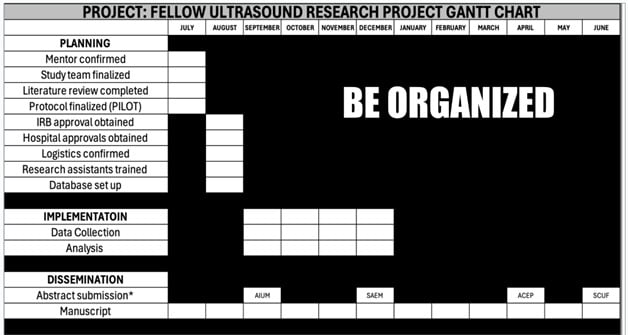 Figure 1. Sample GANTT Chart for an EUS Fellows Research Study
AIUM (American Institute of Ultrasound in Medicine)
SAEM (Society of Academic Emergency Medicine)
ACEP (American College of Emergency Physicians)
SCUF (Society of Clinical Ultrasound Fellowships)
For POCUS specifically, consult the SPUR (Standards for Point-of-care Ultrasound Research Reporting) checklist early.3 This framework addresses the unique considerations of POCUS as a diagnostic test performed by bedside clinicians. It includes considerations about 6 broad domains:
- Technical: What kinds of hardware, exam settings and modes are you using for the study?
- Exam: What is the ultrasound exam protocol? Why was that protocol chosen? What are the minimum views and who is obtaining them? What is the environment for the exam?
- Subjects: Consider the demographic features that are most relevant to your study? In addition to demographics, think about other subject level variables that can affect the exam. For example, a study on cardiopulmonary ultrasound might be affected by the patient’s respiratory rate or ventilatory status.
- Operator: This is the feature that is most relevant to POCUS, often accused of “operator dependence”. SPUR challenges us to address two broad topics: “What is the operator’s level of training and expertise?” and “What is the operator’s relationship to the clinical care team?”
- Analysis and Interpretation: Once the operator acquires the exam, who interprets the images? How this is done is study specific, but the SPUR checklist asks you to think about and justify your process early.
- Study Specific: Pediatrics, procedural guidance studies, and limited resource settings studies have additional specific features to those study types that are worth considering in your study design.
Finally, you can use SPUR to guide the focus of the scholarly project. Many successful fellowship projects address only one of these domains. For example, a project can focus on the technical hardware (“which transducer works best for B lines?”), analysis and interpretation (“how well do experts agree on ultrasound findings?”), or operator training (“how can we efficiently train physicians to perform a fascia iliaca block?”). You can see some examples of successful fellowship projects here. If you or your fellow have had a published project, feel free to drop it in this folder so we can all continue to learn from each others’ successes!
Dissemination
Upon completion of the project, it is important to consider how to disseminate the findings. Often, this begins with an abstract, which can be an optimal opportunity for an ultrasound-interested resident or ultrasound fellow to get early speaking experience and exposure to others in the field. This can also provide an early win to encourage future research interests and help them to be more competitive for academic jobs.
For the manuscript, begin by normalizing the concept of reach journals and potential rejections. Begin by identifying relevant journals. This can be performed using existing programs, such as Journal/Author Name Estimator (https://jane.biosemantics.org/) and Elsevier Journal Finder (https://journalfinder.elsevier.com/), or by reviewing references of relevant articles to see where they were published. Identify a list of one primary and at least 1-2 back-up journals. This sets the expectation that it may not get accepted in the first journal, while also speeding up the process for resubmission if that bears true.
Finally, when the article is published, focus on active dissemination through social media and other avenues. This is a key element to ensure others can learn from the work to inform both practice and future research directions. When engaging in dissemination, tailor the message towards the target audience. For example, summarizing key information regarding a trial should be phrased differently for ultrasound fellowship-trained experts compared to institutional leaders or the public. By tailoring this to the audience, one can optimize the likelihood of engagement and uptake by the end-users.
Conclusion
An emergency ultrasound fellow research scholarly activity is achievable with good mentorship, strategic planning and hard work. There are many benefits to the fellow from participating in research and several excellent resources to help them achieve this goal.
This review was inspired and adapted from a brief didactic that was given by the authors at the annual SCUF meeting. We wanted to express our sincerest gratitude to the SCUF leadership for the opportunity to present and to the several EUS fellowship programs who provided their feedback to our informal survey.
References
- Norvell JG, Baker AM, Carlberg DJ, et al. Does academic practice protect emergency physicians against burnout? J Am Coll Emerg Physicians Open. 2021;2(1):e12329. Available from: http://dx.doi.org/10.1002/emp2.12329
- Gottlieb M, Chan TM, Sebok-Syer SS, et al. The next generation of researchers: One-year outcome data from the SAEM Advanced Research Methodology Evaluation and Design in Medical Education (ARMED MedEd) program. AEM Educ Train. 2022;6(6):e10818. Available from: http://dx.doi.org/10.1002/aet2.10818
- Schnittke N, Russell FM, Gottlieb M, et al. Standards for Point-of-care Ultrasound Research Reporting (SPUR): A modified Delphi to develop a framework for reporting point-of-care ultrasound research. Acad Emerg Med. 2025;32(8):916-25. Available from: http://dx.doi.org/10.1111/acem.70069