 American College of Emergency Physicians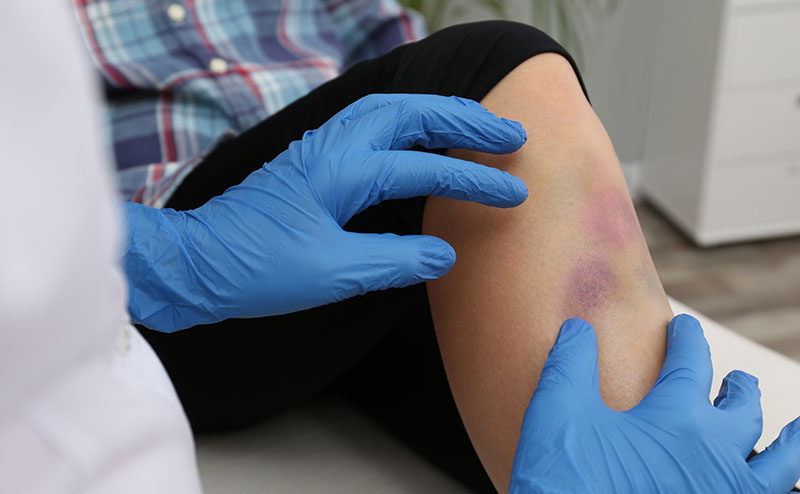

Update on ALS for Occult Bruising: We Need to be Vigilant
W. Anthony Gerard, MD FACEP, FAAFP
A version of this article was previously published on the Forensic Medicine Section Discussion Page under the title: “ALS Cannot Be Used to Detect Occult Bruising in Forensic Medical Evaluations.” Given its direct relevance to emergency practice, a broader readership is warranted. Emergency physicians routinely evaluate victims of strangulation and sexual assault, making familiarity with this issue clinically and medicolegally essential.
Alternative light sources are now routinely employed in forensic medical examinations. Emergency physicians may encounter ALS use directly or through the forensic nurses practicing within their departments. A working knowledge of how ALS is being applied — and the evidentiary limitations of that application when examining skin for occult bruising— is critical for physicians overseeing or collaborating in these evaluations.
In August 2023, Dr. William Green and Gerald Fineman, JD, discussed the “state of the science” on ALS in a webinar. The webinar is available here:
A written summary is available here:
Despite this guidance, some forensic nursing leaders have continued to promote ALS for occult bruise detection — either in disagreement with Dr. Green’s assessment or without awareness of it. A notable example is the publication Improving the Forensic Documentation of Injuries Through Alternate Light: A Researcher–Practitioner Partnership.
The publication notes that while findings from 10 studies suggest that ALS may aid in cutaneous injury assessment, there are currently no evidence-based guidelines for its use and documentation in forensic medical examinations.
The publication poses four critical questions but does not answer them rigorously, instead implying conclusions that are not supported by the current evidence base. In doing so, it suggests that ALS already has an established role in clinical injury assessment. The questions posed are:
- What is the role of ALS in clinical injury assessment?
- How is ALS incorporated into forensic nursing practice?
- How should ALS findings and lack of findings be documented?
- What can a forensic nurse testify to regarding ALS findings?
The current evidence-based answer to all four questions is negative: ALS has no established clinical role yet.This publication and its associated initiatives pose a significant risk of harm to forensic nursing education and the integrity of clinical forensic medical examinations.
Rather than engaging with Dr. Green and other investigators pursuing evidence-based solutions, certain leaders continue to teach and practice based on a misinterpretation of the available science — undermining the credibility of the specialty on this issue.
Most concerning is that these efforts have contributed to the widespread adoption of ALS for occult bruise detection in forensic nursing programs across Maryland and neighboring states, with potential national reach. This adoption is premature, unsupported by adequate scientific evidence, and must be actively opposed to preserve the integrity of forensic medical standards.
One mechanism by which the science is being obscured involves instructing nurses to identify suspected occult bruises using ALS, while documenting findings only as “areas of absorption” — thereby sidestepping controversy without abandoning the underlying, unproven claim. This semantic distinction does not resolve the scientific problem; it compounds it. The implicit assumption among proponents is that these “areas of absorption” represent occult bruising. Adopting this terminology as a workaround is no less problematic than making the claim explicitly, and carries equivalent medicolegal risk. As a result, forensic nurses — many unaware of the ongoing scientific controversy — are offering conflicting testimony in court regarding ALS findings for occult bruising. Permitting expert testimony on an unvalidated and contested methodology is professionally untenable and exposes both practitioners and the legal system to significant risk.
Recent recommendations from the National Justice Dept Protocol for Sexual Assault state, “at this time there is no consensus for using it for this purpose.” An alternate light source (ALS) can aid in examining patients’ bodies, hair, and clothing. Emerging research suggests ALS may help detect and document injury, but again, “at this time there is no consensus for using it for this purpose.”
However, the National Institute of Justice awarded a large grant to a leading ALS supporter to "advance her work on bruise identification using ALS and develop training protocols to translate the ALS technology into practice.”
Experts from our Section, including Dr. William Hauda and Dr. Mo Canellas, have published work supporting Dr. Green’s position that ALS for skin examination requires further research before clinical implementation.
SAFE medical director and forensic nursing leaders should oppose routine ALS use for bruise detection. ALS should be used only for evidence collection, not for confirming or detecting invisible injuries outside formal research. Forensic examiners must not present ALS for occult bruising as a validated clinical technique in testimony.
Consistent with the Department of Justice protocol, a formal consensus process is urgently needed. In the interim, medical directors and forensic nursing leaders must clearly and publicly articulate their opposition to the premature clinical adoption of ALS for occult bruise detection. Continued use of an unvalidated technique risks compromising both professional integrity and the admissibility and reliability of forensic evidence in legal proceedings. Advocacy for victims of assault and strangulation must not preclude good science.
ALS technologies may hold promise for research on occult bruising. Proving ALS as a standalone tool for finding occult bruising may not be possible. It certainly should not be promoted for clinical practice. Instead research may need to focus on finding a validated confirmatory test such as a photographic technique or MRI. Without a doubt, further research on specificity and pitfalls is required before use outside controlled settings.
Forensic medical examiners, including SAFE nurses, must not use ALS for occult bruising outside approved research. In clinical practice, and in legal settings, we must clearly state that ALS for occult bruising is not a validated forensic technique.
We must urge all relevant stakeholders — including emergency physicians, SAFE medical directors, forensic nursing organizations, and legal professionals — to act collectively to halt the promotion of ALS for clinical skin examination outside of approved research. We need a formal, evidence-based consensus on this issue.