 American College of Emergency Physicians

The Novel Ultrasound-Guided Interfascial Plane Block for Shoulder Pain in the ED: A Case Report
Ha-Linh Nguyen, MD
Ultrasound Fellows, Kaiser Permanente San Diego
Gabriel Rose, DO, FACEP
Co-director of Ultrasound Fellowship, Kaiser Permanente San Diego
Keywords: POCUS, regional anesthesia, shoulder pain, interfascial plane block, interscalene brachial plexus block
Abstract
Shoulder pain is one of the most common musculoskeletal complaints seen in the emergency department (ED), and achieving adequate analgesia can often be difficult. The interscalene nerve block (ISB) is well-established for shoulder anesthesia but carries a high risk of hemidiaphragmatic paresis, limiting its use in patients with pulmonary disease or those who need full upper extremity function after discharge. The interfascial plane block (IPB) is a novel ultrasound-guided regional anesthesia technique that targets the axillary nerve within the fascial plane between the deltoid and subscapularis muscles. Unlike the ISB, it spares the diaphragm and most upper extremity motor function, making it a good option in the ED. Here we describe a patient with refractory shoulder pain treated successfully with this technique, discuss the anatomical basis for its analgesic effect, and highlight its advantages over traditional approaches.
Introduction
Shoulder pain is a common condition with a lifetime prevalence of up to 67% in the general population, and ED visits for this complaint have been increasing in frequency as the population ages.1,2 Despite this, achieving adequate pain control in the ED remains challenging. Oral analgesics are often inadequate, and escalation to opioids carries certain risks and limitations.
Ultrasound-guided nerve blocks have increasingly become part of the multimodal pain toolkit in emergency medicine.3,4 For the shoulder specifically, the ISB has been used with increasing frequency, providing reliable anesthesia in acute and perioperative settings.5 However, its use is complicated by hemidiaphragmatic paresis in nearly 100% of patients who receive the block, which can be poorly tolerated in elderly patients or those with pre-existing lung disease.6,7
The interfascial plane block (IPB) is a new technique that targets the axillary nerve (AN) more proximally than the traditional posterior axillary nerve blocks, injecting local anesthetic within the fascial plane between the deltoid and subscapularis muscles. This approach preserves diaphragm function and most upper extremity motor function while providing analgesia along the anterolateral shoulder. Although the IPB has been described in perioperative settings by anesthesiologists, to our knowledge its use in the ED for acute shoulder pain management has not been well-documented.8-10 Here we present a case of refractory shoulder pain treated with this technique in our ED.
Case
A 58-year-old female with a history of calcific tendonitis of the left shoulder presented to the ED with 5 weeks of worsening left shoulder pain. She had been prescribed meloxicam by her primary care physician the month prior without improvement. A three-view shoulder radiograph obtained in the ED showed mild degenerative changes of the glenohumeral joint.
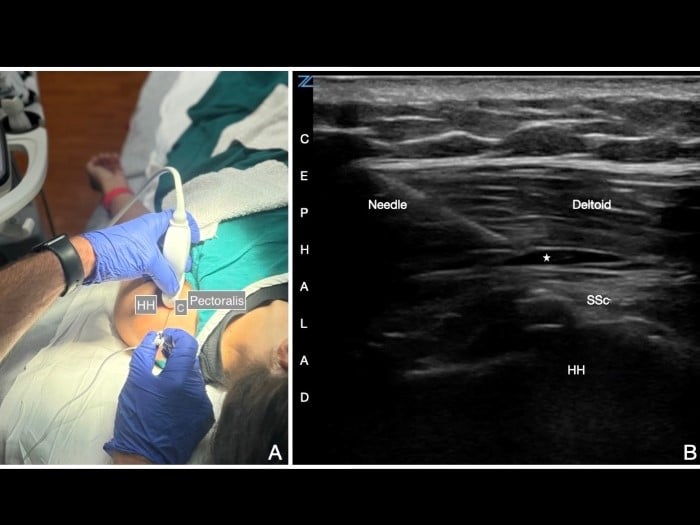
Consent was obtained and the patient underwent an ultrasound-guided IPB. She was positioned supine with the arm in slight external rotation. A high-frequency 10–5 MHz linear transducer (Zonare, Mountainview, CA) was placed longitudinally along the anterior shoulder between the humeral head and the coracoid process in order to identify the deltoid muscle, subscapularis muscle, and humeral head. [Figure 1A] The skin was prepped with chlorhexidine and a 25-gauge 1.5-inch needle was advanced in-plane from cranial to caudal under direct ultrasound guidance until the tip was positioned within the fascial plane between the deltoid and subscapularis muscles. [Figure 1B] Negative aspiration was confirmed and 20 mL of a 1:1 mixture of 0.5% bupivacaine and normal saline was injected without resistance or pain. [Video 1]
On reassessment, the patient reported significant improvement in her left shoulder pain, and was able to fully range her left shoulder without difficulty. She was discharged home with ibuprofen and a short course of hydrocodone-acetaminophen 5/325 mg as needed for pain.
Discussion
This case illustrates the utility of the ultrasound-guided IPB for the treatment of shoulder pain in the ED. With a single injection of 20 mL of 0.5% bupivacaine diluted 1:1 with normal saline, the patient achieved significant pain relief within 30 minutes and was discharged without complications.
The IPB works as a more proximal, anterior approach to an axillary nerve (AN) block. The AN originates from the C5 and C6 nerve roots via the posterior cord of the brachial plexus, providing motor innervation to the deltoid and teres minor and sensory innervation to the lateral shoulder and joint capsule. Traditional posterior AN blocks target the nerve after it exits the quadrangular space but have shown limited postoperative pain relief compared to the ISB, likely because they miss the more proximal articular branches.11 The IPB instead targets the AN more proximally within the interfascial plane between the deltoid and subscapularis, an approach analogous to the Fajardo block technique derived from cadaveric study by González-Arnay et al.11,12 Interestingly, cadaveric dye injection studies have shown spread to not only the AN and musculocutaneous nerve but also branches of the lateral pectoral, lateral supraclavicular, and intercostobrachial nerves, which may partly explain why the analgesic effect extends beyond that of a simple axillary nerve block.12
An important limitation of the IPB is that it does not reliably reach the posterosuperior or anterosuperior quadrants, which are innervated by the suprascapular and subscapular nerves. Therefore, it is not adequate for procedures requiring complete shoulder anesthesia, such as shoulder dislocation reduction or fracture manipulation.13 In those scenarios, an ISB or combination nerve block is indicated.
The IPB offers the emergency clinician several advantages. It is performed from an anterior approach with simple and easily identifiable sonographic landmarks. The diaphragm is spared, making it safe in patients with COPD, obstructive sleep apnea, or other pulmonary conditions. Because most upper extremity motor function is preserved with IPB, patients can be safely discharged without concerns about functional impairment.
Potential complications are similar to those of other peripheral nerve blocks, including infection, bleeding, hematoma, neuropathy, and local anesthetic systemic toxicity (LAST). With 10 mL of 0.5% bupivacaine, the total dose remains well below the toxic threshold of 2–2.5 mg/kg for most adult patients. We recommend a 30-minute observation period on cardiac monitoring following the injection regardless.
Further research is needed to better characterize the role of the IPB in the ED, including prospective studies comparing it to the ISB and intraarticular injections for various shoulder pathologies. Based on our experience, we believe the ultrasound-guided IPB is a safe and effective tool for the treatment of shoulder pain in the ED.
Figures
Figure 1. [A] Transducer and needle positioning. Probe placement is along the anterior shoulder with humeral head, coracoid process, and pectoralis. [B] Injection of anesthetic. Ultrasound image shows local anesthetic (star) lifting the deltoid off the subscapularis. Subscapularis (SSc), humeral head (HH).
Video 1. Real-time ultrasound clip demonstrating needle advancement and anesthetic spread within the interfascial plane.
References
- Luime JJ, Koes BW, Hendriksen IJ, et al. Prevalence and incidence of shoulder pain in the general population: a systematic review. Scand J Rheumatol. 2004;33(2):73-81.
- Hodgetts CJ, Leboeuf-Yde C, Beynon A, Walker BF. Shoulder pain prevalence by age and within occupational groups: a systematic review. Arch Physiother. 2021;11(1):24.
- King SA, Salerno A, Flanagan KJ, et al. Mixed-model curriculum for nerve block education in emergency medicine residency. Cureus. 2023;15(4).
- American College of Emergency Physicians. Ultrasound-Guided Nerve Blocks [policy statement]. Approved April 2021. https://www.acep.org/patient-care/policy-statements/ultrasound-guided-nerve-blocks
- Wu E-B, Wu S, Lai S, et al. Opioid-Sparing Analgesic Effects from Interscalene Block Impact Anesthetic Management During Shoulder Arthroscopy: A Retrospective Observational Study. J Pain Res. 2023;16:119-128.
- Bergmann L, Martini S, Kesselmeier M, Armbruster W, Notheisen T, Adamzik M, Eichholz R. Phrenic nerve block caused by interscalene brachial plexus block: breathing effects of different sites of injection. BMC Anesthesiol. 2015;16(1):45.
- Sinha SK, Abrams JH, Barnett JT, Muller JG, Lahiri B, Bernstein BA, Weller RS. Decreasing the local anesthetic volume from 20 to 10 mL for ultrasound-guided interscalene block at the cricoid level does not reduce the incidence of hemidiaphragmatic paresis. Reg Anesth Pain Med. 2011;36(1):17-20.
- Ray BR, Sanker DU, Bhoi D. B112 Peri-capsular nerve block of shoulder joint as a motor sparing alternative in arthroscopic shoulder surgeries: a case series. Region Anesth Pain Med. 2022;47:A141.
- Atar F, Sipahioğlu FÖ. #35883 PENG block for shoulder surgery, case series. Region Anesth Pain Med. 2023;48:A349.
- Küpeli İ, Yazici Kara M. Anesthesia or analgesia? New block for shoulder surgery: pericapsular nerve group block. Braz J Anesthesiol. 2022;72(5):669-672.
- González-Arnay E, Jiménez-Sánchez L, García-Simón D, et al. Ultrasonography-guided anterior approach for axillary nerve blockade: an anatomical study. Clin Anat. 2020;33(4):488-499.
- Altinpulluk EY, Galluccio F, Salazar C, et al. A novel technique to axillary circumflex nerve block: Fajardo approach. J Clin Anesth. 2020;64:109826.
- Tran J, Peng PW, Agur AM. Anatomical study of the innervation of glenohumeral and acromioclavicular joint capsules. Reg Anesth Pain Med. 2019;44(4):452-458.